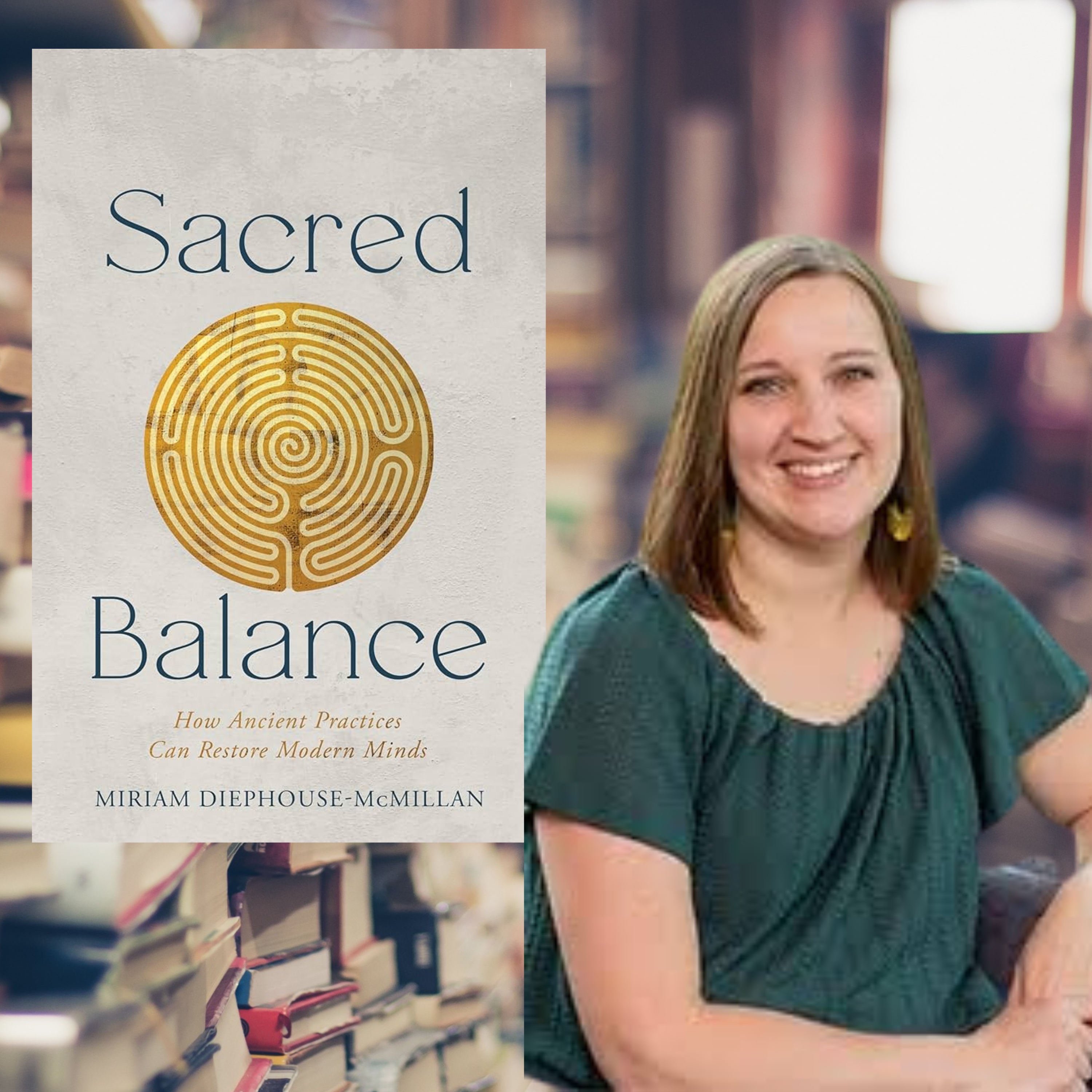
[00:00:01] Speaker A: Hey, friends. Nico here. And I'm so glad you're joining us for another edition of the Collective Table podcast. This episode marks the final gathering in our TCT Book Club series. It has been a gift to read, reflect, and connect with authors and one another around books that invite us into a more inclusive, inspiring and grounded expression of Christian spirituality. Moving forward, the Collective Table will continue to add these book oriented bonus episodes as conversations between our host and featured authors, bringing thoughtful voices, meaningful stories, and fresh perspectives on faith and life. To close out the book club, we're delighted to welcome author, ordained Presbyterian minister, and mental health chaplain, Miriam Deephouse McMillan for a conversation about her book, Sacred How Ancient Practices Can Restore Modern Minds. In this thoughtful conversation, Miriam and the TCT Book Club explore ancient Christian practices that cultivate intentionality, connection with God and self, compassion, making room for gratitude, wonder, healing and spiritual growth without shame. So settle in and enjoy this rich final TCT book club conversation with Miriam Deephouse McMillan right here on the Collective Table.
[00:01:15] Speaker B: All right, well, welcome to the September Book club, everybody. As I think you know, I'm Jason, I'm one of the co pastors here at the Oceanside Sanctuary, and we are excited to welcome Maran Deephouse McMillan. Am I pronouncing that correctly?
[00:01:28] Speaker C: Very impressive. Yes.
[00:01:31] Speaker B: Well, you know, those Anglo names, they're so difficult. Like, you never know, like, if you're gonna get them right, get a lot
[00:01:37] Speaker C: of Die Faust or Dieppe House.
[00:01:41] Speaker B: Okay. All right. All right, great. I needed something to feel better about this week, so. Good.
So, Miriam, thank you so much for joining us. By the way, for those of you who don't know, we originally had Miriam scheduled for last spring, and then just through a series of absolute failures on my part, we totally spaced that. And then Miriam was like, hey, what's going on? And I said, I'm so, so sorry, can you please reschedule with us? And she was generous enough to do that. So thank you for giving us a second bite at the apple. We appreciate it.
This might actually be better timing for us though, it turns out, because it feels like this upcoming year and we tend to think about our year at the Oceanside Sanctuary as like, kind of like the, you know, the school year, you know, like, it's almost like the official liturgical season begins when kids go back to school, you know, and then we ramp up for like, you know, Advent and the holidays, and then we culminate, you know, with Easter and Pentecost, and then we all, like, drop out all summer long. So it feels like this new Fiscal year or new school year or whatever, is kind of starting out with a bit of a theme of us deepening our spiritual lives at the Oceanside Sanctuary. And that's saying something, right? Because we are a progressive Christian church, which means we're really shallow, right? Like, all we care about is love, you know, like, we are not willing to, like, get mean for Jesus. And so, you know, it seems like maybe a little bit spiritual depth would be good for us. And. And so this actually, I think, is really well timed for us. Miriam's book, as you guys know, I think, is Sacred Balance How Ancient Practices Can Restore Modern Minds.
And. And I love this. This is the labyrinth from the French Cathedral. Am I right about that? Am I getting that correct? So my wife Janelle, who's our. Who's my co pastor here at the Oceanside Sanctuary, she has pottery. She, you know, throws pottery as a hobby. And she's been making finger labyrinths, and she's used this same design. So it's kind of been fun to see this book laying around because she also. There's like, you know, half a dozen of these finger labyrinths, they're about this big, laying around our house that she's been making for people that she loves. And so it was kind of fun for us to see that.
But I wanted to read an excerpt from this. This is just from the introduction.
And so early on in the introduction, you are talking about the themes that are woven throughout this book, which I thought was helpful. You talk about the theme of intentionality, being intentional about our spiritual practices, which is super helpful. You talk about how these practices revolve around connection, sense of connection to God, however it is that we imagine God to be in our lives, which I thought was helpful. And then you surprised me with the third theme, which is self compassion.
And so I wanted to read that excerpt and maybe just start our conversation there, if possible. It says a final theme came across. These practices is self compassion.
Spiritual practices can help us build an attitude of acceptance towards ourselves. And our daily experiences.
Connecting with God enables us to see ourselves without the filter of criticism we often habitually apply.
We gradually learn to let go of our expectations and accept our experiences just as they are.
And I think the reason this surprised me is because, you know, we're one of those churches where an awful lot of the people around here have left maybe a higher control expression of religion. And I think one of the. Including, you know, Jenno and I, who are like sort of ex evangelicals who wound up in a mainline space.
And I Think reading that, it just really occurred to me that, that, how did you phrase it, that filter of criticism we often habitually apply, we usually call that the voice of God.
Right. Like the voice of God in our heads is this mantra of habitual criticism or even maybe stronger than that, like a mantra of habitual self condemnation or a mantra of shame.
And I thought, oh, how liberating to imagine that spiritual practices might be liberating from that self condemnation, that self judgment.
And then I was like, oh, now here we are being like, you know, shallow progressives again who all we talk about is like love. And now we're talking about self condemnation, compassion and self love. So I wonder if you could maybe share a bit about like your own experiences around self compassion and how that informed, like this part of, of sacred balance.
[00:07:04] Speaker C: Absolutely. And I think this is probably where my, you know, my mental health experience really shows up because working as chaplain in a psychiatric facility, I would be talking with people a lot about that voice of self criticism and their sort of sense that God is judging them all the time. And I was like, that's, that's not the God that I've experienced in my life.
In, in my life. Yes. I was raised in a, in a sort of Calvinist tradition where there was a lot of sort of guilt and, and expectation of improving yourself all the time, which often manifests as self criticism, and was able to find a voice of compassion amidst that. So for me, it wasn't as much the sort of turning away from what I was raised in towards a different view of God as sort of experiencing God even in the midst of a more, I'll say a more rigid structure, but that my own experiences didn't always line up with the rigidity that I was originally taught.
And then, you know, going to seminary and studying more and saying, you know, a lot of the themes in the Bible are not as clear cut as maybe we like to think they are. And you know, one theme that's pretty clear if you read the Bible all the way through is like God's love, like that doesn't change.
And it's, it's interesting to hear you saying that. That feels like sort of an easy, an easy out for us as Christians because I think I maybe see it the opposite. I think that's actually, in a lot
[00:08:40] Speaker B: of ways and I thank you for that. Yeah, that's very helpful reframing. Yeah, that's good.
[00:08:46] Speaker C: Yeah. I wonder if it's less that, you know, religion has shaped our self criticism and more that we have shaped our faith to fit the self criticism that we naturally apply to ourselves and that learning. And for me and I can get into this in one of the practices in the book is about loving kindness and this structure that it starts with God's love for us, right? Like we love because he first loved us.
But the goal is to love others, right? Love the Lord your God and love your neighbor as yourself. And then Jesus even says, love your enemies. And that's kind of radical. Like that's not something that a lot of other faith traditions teach.
And so the, the structure where it starts with God's love and then that allows us to then love ourselves.
And it's only after we've experienced that love that we find the strength and the reserve to share that love to other people.
And that's something, you know, I've also seen reflected on the mental health side of things, right? This, you know, you can't, you can't offer much to others until you heal yourself. And so it's that same kind of pattern that like we need to be healed, we need to be loved in order to then love other people. And that includes loving ourselves, right? Love your neighbor as yourself only works if you're also loving yourself.
[00:10:13] Speaker B: Yeah, you said that that was maybe a radical thing that Jesus said. And I tend to think of it as annoying, not radical, because I really don't want to love the people who I don't feel love me.
And so I love that you pointed that out, no pun intended, because that is rigorous. I mean, the idea of like learning to love other people when you really try it is very hard.
It takes a tremendous amount of work and self work to come to the place where you can actually love another person in the way that they need it.
Right?
As opposed to the way that you want to give it or as opposed to the way that you want to receive it.
I mean, there's so much there that can be very challenging.
The other thing that you said, by the way, I'll just mention this before the follow up, usually we have a few more people. And so at this point I might normally say, hey, if you have a question, feel free to pop it in the chat.
But so far there are few enough of us that if you guys have like a question that you want to pipe in with, please, you know, wave your arms or something, or, you know, and, and I'll, I would love to, to yield the floor to you.
But as a follow up, you said in that same snippet, we gradually learn to let go of our expectations and accept our experiences just as they are.
And then, you know, before that, you know, accepting ourselves just the way that we are, essentially.
And that's. That's an interesting challenge, too, because I'm like, aren't we in this to make ourselves better? Aren't we in this to improve ourselves? Like, you alluded to that in your experience as a mental health care chaplain. Like, what is the tension between a spirituality that teaches us to come to terms with who we are as good as loved on the one hand, versus, like, I actually want to be different. Like, I. I want to stop hurting myself and others, so I do want to change on the others. So could you speak to that tension a little bit, both as a health care, mental health care chaplain and spiritual practices?
I mean, I don't know if you consider yourself a clergy person. I know you went to seminary.
[00:12:35] Speaker C: I'm ordained in the Presbyterian Church.
[00:12:37] Speaker B: Okay, so you wear both those hats. Like, what's that? What's that tension?
[00:12:41] Speaker C: Yeah, I love that tension. I think that tension is really at the heart of my personal theology.
And that became really clear to me, actually, in my experience in the mental health world. I was privileged to be a part of a program at the hospital that offered what's called dialectical behavioral therapy. And I'm not going to get into the details of what that is, but at the heart of that is what they call a dialectic. These two things that seem opposite but are true, and the way the therapy works is you have to accept the client, the patient, exactly as they are and also help them change.
And that you actually need the acceptance in order to get to the change that we. We can't actually get better if we're spending all our time beating ourselves up for not being better. Yet that takes energy away from our ability to move forward.
And so I think, you know, at the heart of my understanding of God is like, God loves us unconditionally.
[00:13:36] Speaker D: Right.
[00:13:37] Speaker C: Read that over and over again in Scripture. And God is very forgiving, and God is, you know, accepting of us at our worst. And also God calls us to be more.
And those things are not necessarily as much of a contradiction as it might sound that it is.
It is through that acceptance and that love that we find the strength to grow.
And I've, I think, even become more convinced of this as I've become a parent and sort of watching my children and. And the way that they don't grow very well when I yell at them and criticize them. Right. That doesn't actually help them get better. It Usually just makes us miserable.
But when I love them, when I accept them, when I understand where they're coming from and provide information and opportunities for growth, that's when the growth happens. And so it's in that unconditional love and in letting go of judgment that we actually find the ability to grow and to change.
[00:14:36] Speaker B: Yeah, that's well said. Thank you. Yeah.
[00:14:38] Speaker D: Lee, I just wanted to expand on what Jason had read in your intro. There was a part that I really liked that followed, that said, we may not have a profound spiritual awakening, and that is okay. We are still engaging our faith in a powerful way by choosing to connect with God in whatever state we find ourselves right now and letting that be enough.
Spirituality is more of a journey and relationship than an achievement. We can find wisdom and healing by showing compassion to ourselves along the way. Anyway, I just. I really liked that part of that, and that really resonated with me, and it sort of encapsulated what we've been talking about in a nice way.
[00:15:23] Speaker E: I thought.
[00:15:24] Speaker D: So that's all I had.
[00:15:25] Speaker C: Absolutely.
And I think that comes from hearing people, you know, oh, well, I tried this kind of prayer, but it didn't work for me. And I think what they mean by it didn't work for me is, like, it didn't change my life.
Like a miracle.
[00:15:39] Speaker D: Right.
[00:15:40] Speaker C: But that's not really how spiritual practice works. Like, it's practice. It's not, you know, it's not a pill that you take that changes your life. It's something you have to commit to. It's something that you do even when it doesn't feel good.
[00:15:56] Speaker B: Mm.
Yeah. This reminds me of one of the. So I sent Miriam questions in advance, but one of them revolves around this notion that churches, especially Protestant churches, are discovering more and more ancient practices. And it reminds me that there have been sort of phases of this, it seems like, to me. Right. Like Richard Foster in the 1970s. Right. Celebration of discipline has a little bit of moment. And then you have, like, again, thinking from a Protestant perspective, Dallas Willard picks that up again in late 90s, kind of repopularizes Richard Foster. And then Willard really pushes even further into, like, ancient practices as spiritual disciplines. And then, you know, you see, not too much later, like, Phyllis Tickle, really popularizing with the emerging church movement, sort of engagement with, like, the daily office.
You have Episcopalians saying, hey, we're over here. We've been here the whole time. You know, like.
Like, you know, there has been this, in some ways, like, a kind of Protestant migration back to ancient practices. And I'm wondering if you have seen that as you worked on this book or maybe as you have been talking with pastors or churches or congregations about this book.
How have you seen people re engaging with these spiritual practices in a way that is encouraging to you?
[00:17:37] Speaker C: Definitely. I definitely see a lot of churches and obviously, you know, talk to a lot of churches as I'm, you know, talking about the book, who are really at this point where they want individual spiritual growth.
[00:17:53] Speaker D: They.
[00:17:54] Speaker C: It's less a focus. I may, I won't speak for all churches, but there's some recognition that our focus on numerical growth has not served us very well.
And so what.
What does growth look like if it doesn't look like numerical growth?
[00:18:07] Speaker E: Right.
[00:18:07] Speaker C: And so a kind of shifting of that question towards, you know, how do we grow deeper rather than larger is where I see that the most. And I do think it's very encouraging. I think that, that the shift, the focus on numbers didn't serve us very well and is actually continuing to plague the church with its consequences.
And so I'm really excited about the idea that. That there's other work to be done and that maybe we need to be looking more at ourselves and not at why are these other people not coming, but, like, what are we needing right now to get through this time?
[00:18:46] Speaker A: Yeah.
[00:18:46] Speaker E: Leanne One of the things that I really enjoyed about this book, as I was reading through each chapter and at the end of the chapter, how you kind of break it down, how you can be more effective maybe in your prayer and all.
And that was such a great reminder for me. But what I loved is that you brought back some of. I was trying to find specifically. And of course, did I highlight it? No, but, but there were instances where it was like, sit with God and you're, you're spending time. I'm trying to get closer to the divine.
And yet I do these things and then, then I'm done and often and running because there's so many things to do.
And I loved and, and so I, I've been really thinking about when I, when I have my. My quiet time in whatever respect, as I kind of go through this book that afterwards to kind of say, you know, God, this is, this is this gift that you have given me the time to give, use my focus. And I love that, that it brings it back to that. And I think that's the key for me. I'll say for me that when I do these different practices to make sure that I'm including the divine in it, even Though I am, but to recognize that if that makes sense. So I loved that. That's so I appreciate it.
[00:20:18] Speaker C: Absolutely.
[00:20:19] Speaker D: Yeah.
[00:20:19] Speaker C: And I think I often use the analogy that it's like any other relationship.
[00:20:23] Speaker E: Right.
[00:20:23] Speaker C: If you're spending time with family and friends, you don't just say, okay, you get, you know, this one hour, one day a week, and then I'm going to completely ignore you for the rest of the week. Like, that's not, that's not how most of our relationships work. Right. That there is some, some connection that's maintain, you know, something good happens and you want to text your friend or you want to send a, a photo to your family of something good that happened. Right. That there's that ongoing awareness, even in our daily moments of who's important in our lives. And I think the same thing is, is true of our faith.
[00:20:59] Speaker B: It's almost like you're saying, my cat doesn't love me because he ignores me most of the time, like, and I keep chasing him for affection.
Hello, Collective Table listeners, it's CJ again. A lot of people out there might not realize that this podcast is part of a real life faith community. The Collective Table podcast is a production of the Oceanside Sanctuary, a progressive Christian community whose mission is to foster collective expressions of inclusive, inspiring and impactful Christian spirituality wherever it is needed. And as a 501 nonprofit organization, that mission is only possible because of the generosity of people just like you. So if you believe in what we are doing, if you benefit from this mission, please Visit
[email protected] Give to become a supporter today. Together we can keep building communities of love and liberation.
I'm wondering, like, what did that journey of sort of discovering ancient or mystical practices look like for you? Especially since you mentioned a few moments ago that you were raised in a Calvinist tradition. Calvinists aren't necessarily known for being especially mystical or engaged with contemplative practices. So how did you come upon that?
[00:22:35] Speaker C: I was very lucky to have parents who introduced me to a lot of these things. My father is a historian and studies a lot of church history, and so he has some connection. And my mother was actually ordained in the Presbyterian Church as well when I was in probably middle school.
And she was very drawn to the mystical contemplative traditions and brought that into our home life in various ways.
And interestingly enough, she teaches a course occasionally on the mysticism of John Calvin because there are some passages of his writing and his theology that do express an interesting kind of mysticism. That has not been carried out in the traditions named after him. And so that's one of her little pet projects, is introducing people to the mysticism that's already there in the Calvinist tradition.
So that's mostly where I got, you know, the sparks for this project and this interest and then being in seminary and having access to coursework on spiritual practices and learning more of the history for myself and kind of putting the pieces together.
And then I will say, like, dealing with my own stuff, right? Like, going through hard times in my own life and figuring out which practices really helped me.
And I. I think I mentioned in the book that breath prayer is. Was one of the first practices that really hit home for me as like, oh, this actually. Like, this isn't just a discipline. This actually helps me feel better as I feel closer to God.
[00:24:06] Speaker E: Right.
[00:24:06] Speaker C: There is something healing about this practice for me, and that helped me start to connect some of those dots, you know, ending up in the mental health field and. And seeing how that worked for other people as well.
[00:24:18] Speaker B: That's maybe a good segue to the next question, which was, this is certainly true of our church, and I'm sure it's true of a growing number of churches that a lot of our folks are people who either have come through a period of what the kids are calling deconstruction these days and have decided that they still want to be Christian, but having come from maybe more sort of high control environments, were raised with a very limited or narrow set of spiritual tools, right? Like, prayer looked a very particular way, Worship looked a very particular way, reading your Bible looked a very particular way. And then when they've come through a period of really disentangling themselves from a lot of that, they're like, how do. What do I do? Like, do I pray? Like, what?
Like, does prayer make sense anymore? Does worship make sense anymore?
Or even like, people who have come through a place of doubt and have landed and feel like they feel maybe stable in where they've landed cognitively, they don't know what to do affectively.
And so I'm wondering, like, how do you think these kinds of practices could be especially helpful to people like that?
[00:25:39] Speaker C: I mean, I think you mentioned it right at the end there, this. This distinction between cognitive awareness and affective or embodied awareness, right. That so much of Western Christianity has been influenced by this very dualistic understanding of, like, your brain is the good part and you should think the right way and believe the right things and your body and your emotions are the problem, and you should learn to tame them.
And these practices date back prior to that dualism. And therefore, it's just not present in these practices. These practices assume a faith that is embodied.
And I think that can really help people who haven't had that opportunity to engage their faith in an embodied way.
And it. And it has the benefit of kind of shutting down that rational part because a lot of. A lot of the.
The deconstructing work is very logical and rational. And so it's easy as we're, you know, reading scripture or attempting to pray, to get caught up in that kind of cycle of like, well, is this what I believe? Is this the right way to do it?
And so finding a different access point that kind of shuts out some of that overthinking by engaging the physical body and the emotional experience, I think can be very healing and just a very different way to experience faith for those who haven't had the experience of it previously.
[00:27:00] Speaker B: Well, and I thought your example of breath prayer was really a good example because it is a conscientiously embodied act of prayer which requires you to attend to your breath, right? Like, to this bodily function that's normally autonomic, right. Like, it happens, your body will breathe whether you are thinking about it or not. But then it takes this automatic bodily function and asks you to be attentive to it.
Right. And that's such a really grounding way of rediscovering that your connection with God moves through your body. Right. Like, even your brain is a part of your body.
Right? So I love that example.
[00:27:48] Speaker C: Yeah. Any Other is one of my favorites to talk about because it has such, like, everything you just said about the, like, embodied piece of it. And there's so much cool science about how breath works. And I can get really nerdy about the science side of it, too.
But then when you. When you dive into scripture and tradition, like, breath is such a powerful spiritual concept, and in Christian tradition, in a lot of spiritual traditions, right, that breath is. Is identified as, like, the source of our life, our spirit, our soul, you know, the Holy Spirit as this wind or this breath that blows through us. And so it has so many connecting points that make it powerful on so many different levels.
[00:28:34] Speaker B: What are some other prayers that you talk about in the book that you feel, aside from breath? Prayers that are especially embodied for people who might want to explore that kind of side of prayer?
[00:28:47] Speaker C: Definitely pilgrimage. And I. I have, for those who are familiar with sort of traditional pilgrimage where you have to, you know, get on a plane and go somewhere far away. And take a long hike.
I kind of reframe the concept of pilgrimage as any sort of movement.
And it can be often physical, but also sort of emotional movement towards a sacred goal and tying that into some of the, like, civil rights movement and. And the idea of, like, praying with our feet.
[00:29:15] Speaker A: Right.
[00:29:15] Speaker C: The. The ways that we get our body moving in line with our faith. Right. So, you know, whether it's volunteering somewhere, whether it's engaging with a part of the community that maybe we don't necessarily feel at home in, but want to learn more about, whether it is traveling to a new place to see what life looks like in a different space, whether it's going for a walk and experiencing the beauty of creation. Right. There are so many ways that we can physically move our bodies with intention around a sacred goal. And so I think pilgrimage is another.
Another practice that I would highly recommend as a more embodied experience.
[00:29:58] Speaker B: Yeah, I really appreciate that example because I read somewhere recently that when you ask people, there's. I can't. I wish I could remember the source of this. So I'm going to butcher it because I don't remember the source of it. But the gist of it was that there, you know, was some kind of survey conducted. And the question at the heart of the survey was, how do you experience God?
You know, how do you come into contact with God? And this was a survey that was asked of people, regardless of what they identified as, you know, religiously.
And the top two answers were through nature and through other people.
And so, like, when you mentioned pilgrimage, like, I immediately thought of, like, hiking in the woods, because there's something about experiencing the wilderness that immediately connects me to awe and wonder and gratitude and, like, an awareness of my aliveness, you know, all of that.
And. And I think that, you know, something that I'd always taken for granted when I was younger. But I mentioned Dallas Willard a few months ago. He was like my gateway drug to, like, ancient practices in the, like, late 90s.
And so for a while, I was like a Dallas Willard groupie. I would fly around the country and like to hear him speak.
And one. One event where he was speaking, he said something to the effect of, you know, my best times of prayer when I'm gardening.
And I was like, my, like, evangelical youth pastor self was like, what? That makes no sense.
But then, like, as I got older, I realized, like, having your hands in the dirt and working with, like, seeds and plants and picking the product of what you had worked on was an incredibly spiritual experience. If I allowed it to be.
And that feels like akin to or adjacent to this. This notion of pilgrimage, you know, like what you're doing with your body.
[00:32:04] Speaker C: Yeah. And it taps into another one of the practices which is about gratitude. It's a practice that I think maybe I coined the name of. I call it prayerful savoring. But it's this act of gratitude that is not a sort of retro. Often our. Our gratitude practices are retroactive. Right. At the end of the day, you look back and a list of the five things that you're grateful for. And there's a lot of that in the mental health field too, in terms of like, journaling practices and things like that.
But I wanted something that was intentionally focused on present moment gratitude and connecting that to sensory awareness and sensual experiences. So, like, how are we experiencing God? Through our taste and our sound and. And our physical touch.
[00:32:50] Speaker E: Right.
[00:32:50] Speaker C: What are things that we can experience here and now in this moment that help us appreciate the things that God has done? And so nature is a great one for that as well. Right. That you can just sit. You know, I grew up in Western Michigan and often go back to visit in the summer, and we sit by the shore of Lake Michigan as the sun sets over the lake. And for those who aren't familiar with the Great Lakes, it's not a tiny lake, it's like an ocean. And so, you know, you see the sun setting over the lake and just sitting and soaking that in as a spiritual practice. In that moment, an awareness of, like, God, who created this beauty for me to enjoy.
And it's okay to just sit and enjoy it. I mean, that's a. That was a learning path for me from my Calvinist upbringing. Like, it's okay to just enjoy something for a minute. You don't have to be like, working towards a goal every second of every day.
[00:33:41] Speaker A: Right.
[00:33:42] Speaker C: Like, you can suffering it.
Yes. That enjoyment is a spiritual practice.
[00:33:48] Speaker B: Yeah, that's good.
[00:33:49] Speaker E: And thinking about that, I loved how you brought it back with each chapter in each practice. You brought it back to being in the moment, being aware.
And you know how many times I'll think I'm so aware, but if I sit down and I really am am aware, there's a totally different response that my body has, my heart has, and I. So this has been a really. It was a really wonderful gift. And I read it before, and then I read it again.
[00:34:27] Speaker B: Leanne, you're just sucking up. You're just totally sucking up to Miriam.
[00:34:31] Speaker C: I'll take it.
[00:34:32] Speaker B: You'll sign your book if you really want her to.
[00:34:36] Speaker C: You have to get it to New Jersey. But yes.
[00:34:42] Speaker B: So one of the other things about being like the kind of church we are is that we're very engaged in like, social justice issues. And so because for an awful lot of our people, they were discovering that their faith might have some bearing on like, policies that exacerbated local hunger or, you know, the growth of the unhoused population in our city or police, you know, unethical police practices in our city. So our congregation's very, very engaged in like, advocacy efforts and protest and, you know, like, there's a handful of people here who organize all the local no Kings protesters. You know, it's not a church ministry officially, but it's might as well be right. And there's a team of social justice minded folks here who have been working for years, literally for years to try to change local policies around police practices or more recently around food security legislation at the state level.
And the thing that Janelle and I, my wife and I have learned by being a part of a church now for about 10 years that's really steeped in that kind of work work is it is exhausting. And more than exhausting, like, it's actually more hopeless than hopeful because it's so hard to affect systemic change.
And so one of the things that we've learned, especially from communities of color who have been doing this kind of work for decades, and you know, you mentioned the civil rights movement and how that also is like a spiritual practice of engaging your body. I was so glad that you mentioned that because I think one of the things we've learned from, like partnering with local congregations of color around these issues is that they don't forget to celebrate. They don't forget to, to pray in a way that is an expression of their, like, gratitude or their prophetic hopefulness.
So I wonder if you might speak to that. Like, how have you seen ancient practices become.
Are a source of grounding or joy or refreshing for congregations that are really engaged in that kind of work? Or have you? You know, I make. I guess I'm sort of assuming the answer when I ask that question.
[00:37:14] Speaker C: Yeah, I mean, at the very least in my own life, but. But hopefully also in other churches and places I've connected with that. The biggest piece for me is that awareness of both connection to, but also only being a small part of the work that God is doing.
[00:37:34] Speaker D: Right.
[00:37:34] Speaker C: That like, I am a small piece in the larger puzzle of all the work that the Holy Spirit is doing in the world right now. And I don't have to be responsible for the outcomes of all of it. Right. I think especially as, you know, white WASPy Christians, we tend to think we're in control of situations because that's a privilege that we've experienced a lot. And spiritual practices can kind of take us down a notch in a healthy way and remind us, like, this isn't your problem to solve. Yes. You have a part to play, and it's important that you show up and that you do the hard work, and then it's okay to trust that other people are also being called to that work and change will happen.
[00:38:19] Speaker E: And.
[00:38:19] Speaker C: And I think the practices that can kind of put us in our place in a healthy way, where our place is not, you know, minuscule and useless, but it's also not in charge of everything.
[00:38:32] Speaker B: Yeah.
[00:38:33] Speaker C: Temper some of that hopelessness.
[00:38:35] Speaker B: Sometimes it almost feels like a.
Like, with a thing we talked about earlier, the tension between, like, accepting myself as I am versus the impulse to grow in a healthy way.
Like that tension at social scale. Right. Like realizing, like, at social scale, there's a sense in which we need to be. We need to accept, and there is a sense in which we need to learn how to change things in a healthy way. But that tension is real. Right. Like, it's a constant kind of struggle between the two.
So that occurred to me while you were talking that you had kind of spoken to this already, just at an individual level. Right.
[00:39:18] Speaker C: That's very much true. And I. I speak briefly in the book about my awareness of Zen traditions and mindfulness practices. And I think there is some interesting learning to be done from Buddhist traditions around that connection between, you know, contemplative practices and social justice.
And I think when you dig into the heart of contemplative traditions across religious lines, there is some shared wisdom there about, you know, acceptance and. And using acceptance as a platform for action.
[00:39:56] Speaker B: So you'd spoken earlier, too, about your experiences, and you write quite a bit in the book about your experiences as a mental health care chaplain, which must be exhausting and rewarding all at the same time. I can only imagine.
But I'm glad you're doing it. I'm glad somebody's doing that. I definitely could not do that.
But I bring it up because one of the things that you actually allude to in the introduction is that there is often this adversarial relationship set between the spiritual and the therapeutic. Right.
Churches and church leaders often will sort of denigrate a certain kind of expression of spirituality or religion as being merely Therapeutic reminded. Like, years ago, Christian Smith, the sociologist, wrote a whole book where he analyzed the millennial generation when they were teenagers, and he concluded that their version of spirituality was what he called moralistic, therapeutic deism. Right. And like, that phrase has been like the whipping boy of certain expressions of Christianity ever since. Right. Like the religion you're promoting or practicing is. Is merely therapeutic. And I wonder, like, as both a spiritual professional, a religious professional and a mental health professional, like, what's your take on that dualism between those things? Like, how do you address that?
[00:41:27] Speaker C: I think there, like many things, there is, you know, some truth to it, and it does not capture the whole picture. I think there are ways in which mainline Christianity dropped the ball and made it all about how we feel and whether we feel good or not.
And missed this part that we were just speaking about, about the social justice about. You know, it's not about making yourself feel good just so that you feel good.
It's about giving you what you need so that you can go out and be the body of Christ in the world. And I think that's the piece that I think pulls the sides together for me.
And I think what was interesting to me being in the mental health field is that it seemed like the mental health field was warming up to spirituality in some ways faster than faith traditions were warming up to the mental health field, which was fascinating. So, you know, there's a lot of conversation now about no spiritually informed therapy and, like, cultural awareness, including awareness of religious perspectives, and not kind of only seeing faith as something that causes neuroses, but actually seeing the ways that it helps people. And there's some great research out there actually proving that, you know, seeing these correlations between identification, faith and resilience or other, you know, indicators of mental well being.
So I think that was interesting for me to then be coming at it from the other side and say, okay, well, where.
[00:42:58] Speaker E: How.
[00:42:59] Speaker C: How do we get churches to see that this is a part of our work too?
[00:43:03] Speaker E: Right.
[00:43:03] Speaker C: That healing is something that is promised to us, but it's not just for us. It's also for the world.
[00:43:12] Speaker B: Yeah, that's great.
Okay, So I feel like I've been dominating the conversation with Miriam, so I apologize to the rest of you, but I want to pause here and just maybe give you an opportunity to ask any questions that are floating to the top of your head or that you've been sort of musing on while we've been talking, or if you don't have one at this point, I wonder, like, as you read through Lee or Leanne or Samantha. Hello, Samantha. Welcome. Samantha popped in a few minutes ago while we were chatting.
As you were reading through this book, was there a particular practice that you encountered in the book and you thought to yourself, oh, that seems interesting. Like, you know, I find that intriguing, and I'd be interested in trying that if you haven't already.
And if so, like, would you be willing to share that with Miriam?
And, like, you know, like, what if you could ask her, like, hey, what if I wanted to try this? You know, like, you can't call her up in Jersey anytime, but you have her here now. What questions would you ask?
You know, I'm putting them on the spot.
[00:44:31] Speaker D: I don't know that I had a question exactly, but there were a couple of the chapters that were really interesting to me. One was the way that you expanded the labyrinth idea and the different pilgrimage ideas that you had. I thought those were fascinating because I've always thought of a pilgrimage as, you know, off we go to the mountains for 10 days or whatever. It had to be something that was a really big deal to incorporate into my daily life.
And I'm really looking forward to trying some of those very basic, you know, we're blessed here in Oceanside. We have a mission, and there's a labyrinth there to walk. And I've walked it before, and I love it. It's just amazing.
And just the idea of expanding the way I think about going on a pilgrimage was a real gift.
And then my other thought was that I really loved the chapter that you did on Soul Friends, you know, and the whole Anam Kara idea and the concept. I just really appreciated the way you laid that out.
I really liked that emphasis on listening and being present and not, you know, advising or coaching or, you know, all those things which are like, you know, that's my immediate instinct. Right? You know, I have to. I have to fight that, but, you know, to just be there, you know, And I like the suggestions you had for regular practice and those kind of things, but I just thought it was a really lovely description of the best we can be with each other. So, anyway, that weren't really questions, but just comments.
And I also am really looking forward to. I. I love the idea the way that it's broke down and broken down into fairly succinct chapters, because sometimes practices for me get stale, you know, and it's just. It's just like, I just want something else, you know, like, whatever I was doing that was working great two months ago just isn't working that well.
So I really like the way that this is presented because it's really easy to pick this up and say, oh, I think I'll try this anyway. That's all I have. But I really appreciated the book. Thank you.
[00:46:53] Speaker C: Thank you, Lee. And I will say that that structure, again, is probably influenced by working in mental health, where we're always talking about people's toolbox. Like, what coping skills are in your toolbox, and what can you pull out? And maybe you need a new one. Like, maybe you need to try a new tool. And I think that frame really helped me as I was shaping the ideas for. For the book of, like, what are the tools in our Christian toolbox? And it, you know, we don't have to start from scratch. There are a lot of them already out there. Let's put them together so that when we need a tool, we can dig in there and. And try one out and see what works.
So I'm glad that that's helpful.
[00:47:27] Speaker E: Some of the words I loved were, well, prayerful. Savoring. When you. When you bring it back to your. Your savoring something and just reading, you know, savoring requires us to engage in moments of joy as they arise, as opposed to being.
It's all about focus for me right now. And as I was reading through each of these disciplines, I was thinking, this is focus. It's one thing to say, oh, I do this, that, and the other thing, but if I'm not focusing, if I'm not savoring those moments, and so there are words in here that just really spoke to me, and savoring was one of them. So I'm challenging myself to be. Be more aware of that. So I. I just loved it.
[00:48:12] Speaker C: Thank you, Leanne.
[00:48:14] Speaker B: I wonder if we could talk a little bit more about, like, what you wrote about soul friends, because, you know, and this is part of what you wrote, but it feels like there's a crisis of genuine friendship in our society at large.
And. And even in congregations like ours, it feels like people have sort of two postures. One is sort of arm's length.
I don't want to get too close, because I've been there and I've been, like, you know, burned, especially, you know, in congregational settings.
And then the other posture is, like, too close, right? Like, too close, too fast.
Like, I need you. I need your attention. I need you to fix my problem.
Or, you know, it's flip side, like, I need somebody whose problems I can fix.
And. And oftentimes it feels like there's what's lacking in.
In the. Either of those situations is like a genuine intimacy, like the kind of intimacy that can be really close without having to fix or trying to fix, which is what you talk about. But I wonder if you feel like there's something about, like, our social structure at this point in our history as a country or our deepest values as a country that keeps us from having those kinds of healthy, intimate friendships.
[00:49:49] Speaker C: That's a hard question. I think there's a lot of factors, I don't know that you can, you know, nail it down to just one. I mean, I think our culture, especially in contrast to other cultures around the world, American culture, does have this value on individualism, right. That I should be able to do it myself. And so there's this fear of vulnerability, right, that I can't ask for help or I can't share the problems in my life because that means I'm not successful. I'm not presenting myself as a successful individual. So I think that's one piece of it. I think social media and the technology we have access to, you know, there's. There's plenty of other books you can go read about the impact of social media on our relationships. But I do. I think there is a sort of a superficializing of relationship that happens.
On the flip side, I will say I know pockets of communities and subcultures who have used technology to build deeper connection than they were able to find before, particularly minorities and. And those who are maybe not feeling accepted in the general culture are able to maybe build connections. But those who are in the majority, I think it functions as a way to distance more than to connect.
So, yeah, I don't know exactly how we ended up here. I think there are a lot of factors, but I think a lot of it comes from a fear of vulnerability.
[00:51:17] Speaker B: So someone in our congregation has never practiced these sorts of things. They were raised in a tradition that didn't talk about centering prayer or pilgrimage or Ignatian examine.
Right.
I would like. What would you recommend they start with? And how would you advise they pay attention to their beginning practice?
[00:51:44] Speaker C: I think I don't. I wouldn't have one practice necessarily that I would recommend because I think it is very individualized. And so I like that idea of a toolbox where different people are going to need different things, and you may even need a different thing at a different time in your life than what you need right now.
But I think some of the.
The tips that I offer, like, I think in several chapters, I talk about starting small I think sometimes when we think I'm going to start a spiritual practice, it's like, okay, I. I need to commit to a full hour every day of reading my Bible, or I need to do centering prayer for 45 minutes a day, and then we try it twice, and we're like, that was miserable. I'm never doing that again. Right? So, like, sustainability, I think, is. Is what I'm getting at, right? That. Start at a small level, try it out, but be consistent, right? So focus on something that you can sustain over a longer period of time.
And then that line from the introduction about, like, not expecting a miraculous, you know, spiritual awakening, right? Because then you're setting yourself up to be disappointed, right? So make it just okay. I'm gonna spend a couple.
A couple minutes every day just sitting with God. I.
I shared in the book that the. The outlines of the chapters actually came from a small group study that I did at my home church where we were kind of working on mental health and spirituality. And what would that look like? And I was like, here's some practices. Let's try them out.
And I remember one of the women in the group sharing that the only free time she had for these practices was while her children were brushing their teeth at night, that they go brush their teeth, and she would sit in a chair for five minutes while they brush their teeth. And whichever. The practices we were talking about that week, that was her five minutes to do it. And I was like, that's such a great example of, like, making it sustainable, because, you know, you have that time every day. It's part of your routine. And it's not this expectation that you have to sacrifice, sacrifice all the other things you have going on in order to have a spiritual practice that you can fit it in in a way that works for you and your life. And you're more likely to keep up with it if you do that than if you make unrealistic expectations. So starting small, being consistent, and just try it, see what works.
[00:53:57] Speaker B: That's great advice. I appreciate that.
So it occurs to me that it's getting close to 10pm where you are, so thank you so much for staying up late. I don't know what your normal bedtime is, but I know that my bedtime is typically earlier than 10pm so we're grateful that you gave up this time. Any final questions or comments anybody has for Miriam Deephouse McMillan?
Any questions you have for us?
Not that you were expected to.
[00:54:31] Speaker C: No, I'm. I'm very grateful for each of you and for the conversation. These are the kind of things I really love talking about. So it's, it's bringing me joy and it's, it's always fascinating to think about the ways that these values and these practices are bubbling up in similar ways in many different places around the country and around the world. I find that really exciting and hopeful. So it's great to speak with you all tonight. I appreciate it.
[00:54:59] Speaker B: Yeah, it is helpful. I agree. And, and we really appreciate your availability and really love that you got to kick off our new season. This is our first book club for sort of our new, our new season this year. And so really excited to start with something that's both practical but also really like thought provoking. Like, it really asks us to go deeper in a different way than maybe like the theorizing that, you know, other approaches might take. So we really appreciate that. Well, thank you so much for joining us and we will let you go.
Everybody else, thanks for joining us for our first book club this year. Thanks for being here tonight. And we will push this out on the podcast next week for those of you might want to re listen to it and, you know, see if you might get a little bit more out of it.
Thanks you guys.
[00:55:50] Speaker D: Thank you.
[00:55:52] Speaker E: Bye. Bye.
[00:55:53] Speaker B: Take care.
[00:56:00] Speaker A: Thanks so much for joining us for this episode of the Collective Table podcast. If you enjoyed the podcast, please consider leaving us a review. If you are interested in the broader work we do here at the Oceanside Sanctuary, please visit us online at www.oceanoceansidesanctuary.org. we will see you next time.