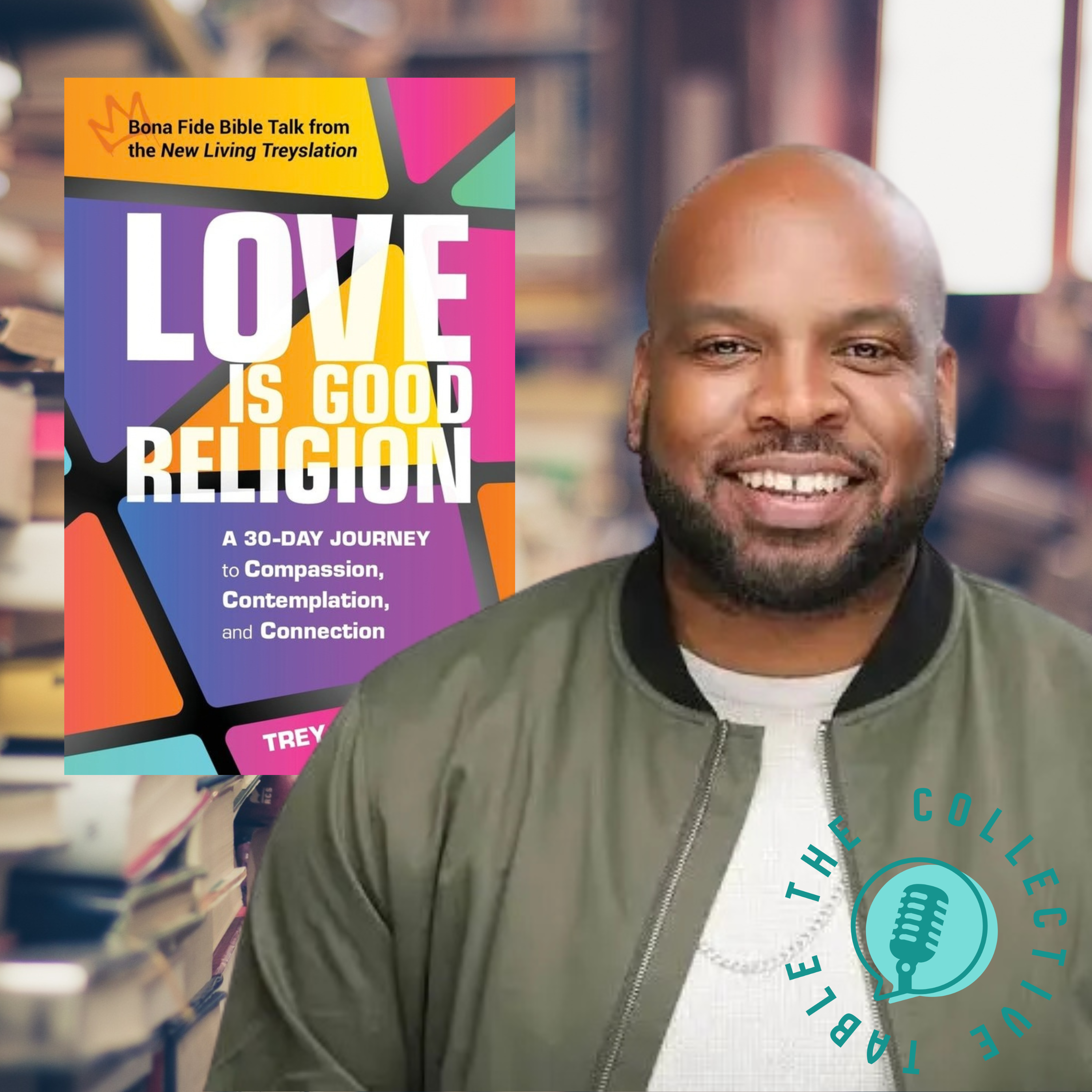
[00:00:00] Speaker A: Welcome back to the Collective Table podcast, friends. This is your co host, Jason Coker. And I'm excited about today's episode.
I have the opportunity to interview Trey Ferguson, who is the author of a brand new book called Love is Good Religion. Now, Trey is a fantastic guy. He's a pastor and an activist, recently became the new pastor of Raleigh Mennonite Church in Raleigh, North Carolina. And he has written a book before called Theologizing Bigger. And what I love about Trey is he takes a very unique perspective on how to unpack scripture and the stories that really form and shape our faith. So I'm excited to share this conversation with you, but I also want you to know this conversation represents a bit of a shift in how we're going to be doing these author interviews. In the past, we've had live conversations with our Zoom Book Club, but moving forward, we're going to record these in advance so that we can have a little bit more intimate conversation with the authors themselves. And so this episode with Trey is our first episode that takes that approach. So I'm excited to share this with you and look forward to your feedback and your input. And also, if you can send us your recommendations for the books that you would love for us to cover and the authors that you would love to hear us talk to, we'd love to bring that to you as well, if we possibly can. So without further ado, here is my conversation with Trey Ferguson.
[00:01:38] Speaker B: All right. Well, good morning, Trey Ferguson. How are you today?
[00:01:44] Speaker C: You know, I can't complain at all. I'm doing all right. The temperature just dropped over here in North Carolina. It's like low 60s, and I'm appreciating that. So that fall, autumn isn't just a slogan, but an actual experience. And, you know, I'm grateful for the day that the Lord has made today, whatever that is. How you doing today, Jason?
[00:02:04] Speaker B: Yeah, I'm good. I'm good. The temperature has dropped here in Southern California recently. And so in San Diego, we're in San Diego county. And, you know, if it gets above 70 degrees or below 65, people here complain bitterly as though they're suffering, you know, in a real way. And so it's been in the, like, low 90s for, you know, a good stretch this summer. And so lately, fall is here. And so, you know, we're back in our comfort zone, so to speak. But you, you. I just learned that you recently moved to Raleigh, North Carolina, from Miami. So you traded, like, you traded climates
[00:02:42] Speaker A: a little bit, right?
[00:02:43] Speaker B: Like, it must have been hotter where you came from?
[00:02:46] Speaker C: Yes. Yes. Well, I don't know. It's been pretty hot over the summer here in Raleigh as well.
The humidity, I've experienced it a little bit differently and I was actually, I was actually excited to get away from some of that. And especially like most of the year around, like it's hot and then hot and wet in Miami, but it's like hot and rainy wet as opposed to just hot and moist, which is the humidity. You walk outside and you're wondering why you even bother taking a shower because you're just sitting and you don't sweat all day. So I've been fine with getting away from that around the calendar, you know.
[00:03:19] Speaker A: Yeah.
[00:03:20] Speaker B: Yeah. Well, we lived in Columbus, Ohio for a couple years, my wife Janelle and I, and we're from Southern California, so I thought I knew what humidity was like until we lived in Columbus. And then I thought we were going to die.
And I don't even think that's as bad as South Carolina. So I, I can appreciate where you're coming from.
Well, thanks for joining us on the podcast today for the Collective Table. This is kind of our church's like in house podcast. So just to give you a sense of like, what's going on, our church folks will listen to this podcast as a way for us to like engage with authors or tell stories. And so we kind of go back and forth between like long form stories and interviews with folks like you. And I was excited to talk to you because your new book, Love is Good Religion just came out. This is actually your second book, a follow up to Theologizing Bigger. And so like, you are cranking out books. Trey Ferguson, I. So I want to say congratulations because I think even writing one book is an impressive feat. So here you are turning around another one. And all of this is a part of, unless I'm mistaken, correct me if I'm wrong, all this is part of kind of a bigger project for you called the New Living Translation.
Right?
[00:04:40] Speaker D: Yeah.
[00:04:41] Speaker C: Yeah. Well, this book came out of the New Living Translation and maybe one day translation turns into something else. But right now it was just a contributing factor to this book right here.
[00:04:52] Speaker B: Okay. Okay. Well, maybe we'll get a chance to talk a little bit about that because I'd love to hear kind of where that's coming from.
But maybe, maybe before we do, I wonder if you maybe could just tell us your story. Like, what's your story? How did you end up as a pastor? I don't know if you've heard, but religion as an industry is not doing so well.
So at what point were you like, hey, that seems like something I'd really like to do.
[00:05:16] Speaker C: Yes. It's funny. A few years ago, my wife and I were looking at the results, like these rankings of the most worthless degrees, and the top three were communication, psychology, and religion. And between the two of us, we have two psychology degrees, communications degree and a master of divinity. Right. In theology.
So we. We have committed to a life of voluntary poverty, I suppose, according to that chart.
No, that's a great question. I didn't really imagine myself doing this. Well, when I was young, growing up at church, at one point I said that I wanted to be a preacher and the pastor of the church. When I told him that, and I was like 8 or 9 when I said this, he said, okay, yeah, first step, read the Bible. And I said, you know what? Being a fireman sounds really great.
And so. So I, like I said, grew up in the church.
And the very moment that there was an option for me to do something on a Sunday morning other than go to church, I took advantage of that. And I never stopped calling myself a Christian.
But there was definitely a time of exploration and reevaluating exact where I stood or not exactly, because I don't know if I can ever pinpoint exactly where I stand in relation to the divine, in relation to God.
But at some point later in life, in college, I met this young lady who I found very attractive, and I wanted to be where she was. And she didn't grow up in church, but she was curious, and she asked if I would explore charges with her. And so I agreed to do that because I wanted to be where she was.
And that drew me back into life of faith. And God has a funny way of working, because that. That lady is not my wife.
And in that process, you know, I stepped into this vacuum where the guy who was running the youth ministry had moved away, and I saw all these young people needed, like, somebody to do something. So I stepped in there, and that was kind of my doorway into ministry and wherein I realized that I actually liked telling stories, right? Not making up stories, but I found I was captivated by the story of Jesus and the story of God and that narrative, seeing how that comes to bear in the life that we have now. And I quickly realized that, you know, a lot of people use youth ministry as a stepping stone into, you know, big ministry, right? And I didn't want to be another one of those guys. I realized that that wasn't really where my passion or Even necessarily my gifting was that I just tried to step in and fill a void. And so I was like, you know what, let's, let's see what this leads to. And you know, couple of stops of seminary later, I found myself really in this life and I left the corporate world, you know, human resources and it, and made the very poor financial decision to do this, this ministry journey. And I haven't regretted it a day in my life because some of the best advice that I ever got when I first started ministry, they said if you can do something else, do that.
And if you can't, then you have like a pretty good idea that this is what you're supposed to be doing.
And I rarely feel like I, like I'm going to work. Like this isn't something I have to do, it's something that I get to do, which is fortunate because like I said, it's fortunate that I feel this way because it doesn't necessarily pay that well.
[00:08:51] Speaker B: But no, and then all my non Christian friends dread. All my non Christian friends tell me like, hey, all the preachers I see on TV are rich. You must be doing this wrong.
[00:09:01] Speaker C: Right, right, right. And I hear that and you know, I, I, I might have misplaced the keys to the private jet or something, but it's been, it's been a long while since I was able to take advantage of those perks. And so now most of the perks that I get now involve things like.
Yeah, I guess, I guess I'm well acquainted with some of the local hospitals. You know, sometimes, sometimes I could find like the convenient spots in the hospital parking garages when I'm visiting people. And, and yeah, you know, it's a cool life that we get.
[00:09:41] Speaker B: Yeah, I mean, you know, it's a bit of a joke, you know, about the private jets and you know, rich preachers on tv. But it occurs to me that something that is the source of a lot of like consternation in our, in, in our profession and also our churches is that there really are competing versions of Christianity. Oh certainly. And, and this, the difference between differences, I should say, between some of them are really stark. And so, you know, I'm often telling people there is no Christianity, there are Christianities.
And that, that doesn't, that's not an effort to other the people that we disagree with who also claim Christ. Hopefully it humbles us to realize like we have work to do to translate. Right. And yes, and, and I, and I think the reason that I'm, I say this is because I think this is a big part of what you're doing. Unless I'm mistaken in Love is Good religion is. You're, you're, you're staking a claim about what love is.
[00:10:52] Speaker C: Yes.
[00:10:53] Speaker B: In a way that's different than some of our siblings in Christ might be staking a claim about what love is. And so I wonder if you could speak to that a little bit in this book for, you know, the folks at the Oceanside Sanctuary or other people who might be listening if they pick up Love is Good Religion.
What stake will you claim about what love actually is and why it matters most?
[00:11:20] Speaker C: Simply put, I maintain that love is the commitment to wholeness. If I were to draw that out a little bit, I would say the love is the giving of all that one is, has and does for the positive benefit of another, expecting nothing in return.
And if that is the case, then we have to reexamine some of the stories that we tell about God, even from a Christian framework. Right.
There is a way of describing the gospel that says that the good news is that Jesus is the Savior for the sins of the world.
In a micro sense, for my own sin. He's my personal savior in a macro sense, like the savior of the world. Right. And I think that most Christians would agree with that on most levels. I don't have a problem with that thesis. It's the antithesis that we have to look at. What problem is that solving? What are we being saved from? And there's one narrative that says that we have become so depraved that we require salvation not only from our state, but from what we rightfully deserve from God. That God cannot be the presence of sin without an atoning sacrifice, and that Jesus comes in to take on the penalty that we deserve according to God.
And that's an interesting narrative because it suggests that we are so wretched that God can't stand us without this gory sacrifice that is exemplified in torturing Jesus to death, but naked in the middle of the street outside Jerusalem. Right. And that's an interesting story because absent the emotional music and the heartfelt preaching, that could hardly be described as good news.
That, that, that, that God can't stand to be around us until somebody volunteers this tribute or we step up and get flayed in public. And now God says, okay, now, now that good and just. Right?
[00:13:16] Speaker B: Yeah. Don't you think that's like. I'm sorry to interrupt, but like, I think what you just said is really helpful and really powerful. Like you said, that's hardly good news. For anybody.
And I. I'm not necessarily disagreeing when I ask you this question, but isn't it maybe important also to ask who was this formulation of the gospel good news for?
Because it. It serves somebody's interests to formulate the gospel in that way.
[00:13:40] Speaker A: Right.
[00:13:40] Speaker B: Like there's a power in formulating the gospel that way. Like, there's a reason medieval European peasants, you know, somehow were able to be engaged with that.
[00:13:54] Speaker C: Yeah. And I'm not even sure if it's fair to put that on the peasants, because the.
[00:13:59] Speaker B: Oh, no, no, no. Definitely not.
[00:14:01] Speaker C: Yeah, yeah. And the truth of the matter is that, like, right now, when we get into the wheeziness, we're in nerd territory right now. There is a luxury, there's a privilege involved in being able to parse out atonement, the. And the different things of the gospel's expression over time. And so it's a privilege to be able to engage in this work. But for me, it's important that somebody sits down and does it, because the implications of this are rather large. Because if that is what we accept as good news, what does that do to the ways that we interact with ourselves and our neighbors? How does that impact our view of ourselves and our own dignity and worth? How does that impact how we view grace? How does that impact how we view justice? What does that mean for the ways that we structure our societies if we believe that inherently God cannot stand us apart from somebody suffering, apart from somebody being tortured, apart from somebody laying down everything. And it doesn't matter who that person is, apparently, whether or not that person is guilty. But that story is interesting. I don't know, somebody hears that and say, well, no, this is a story of love because God sent us the perfect sacrifice in our place. And there's no other situation where we would accept that as a definition of justice. There's no other situation where we would accept that as an image or a picture of love, that somebody that we love that dearly we would allow to stand in place of somebody else receiving what they deserved, Allegedly. And also, how is it that we are fine saying that God thinks anybody deserves to be tortured to death in the middle of the street but naked? Right.
And so for me, it's important to, like, name and wrestle with what love is and is not.
Because in a vacuum, if I'm sitting there trying to evangelize to somebody, I have to do a whole lot of legwork to present what I just described as loving.
I really do.
Now, there's an alternative because of that
[00:16:01] Speaker B: because of that other story, do you find in your engagement with people and your work at the church or in the community that people are carrying that, you know, Reformed version, that hyper reformed version of, you know, total depravity? Like, is that a common story that you run into?
[00:16:23] Speaker C: It is a common story that I've run into in many of the places that I've served. Where I do right now, it's not as common. Yeah. From an Anabaptist perspective, it's not. It's not really.
[00:16:32] Speaker B: It's not their story.
[00:16:34] Speaker C: Right, right, right. And I haven't always served in Anabaptist communities, and so it's a little bit different. But I think here in the west in particular, it is very loud narrative to the point where when I'm as clear and pushing against it as I do right now, that doesn't come without its detractors. There are a lot of people who will insist that I'm pushing a false gospel, even though everything I'm saying right now is well grounded, not only in scripture, but like, in Christian history. Right. But a few interpretations of Isaiah, chapter 53, and then this weird thing where we cut and paste scriptures together like a ransom note, make this other version seem bulletproof when it's absolute minority view in the grand scheme of thing, not only today, globally, but throughout Christian history. Especially throughout Christian history. But even today, when we think of all the different schools of Christianity.
[00:17:19] Speaker D: Right.
[00:17:21] Speaker C: And as to your point, there is no Christianity. There are Christianities.
Because the alternative narrative, the one that I am pushing, the one that I'm trying to present to people in this idea of love being good religion, is the idea that God is grieved by the suffering that we endure in this world largely because of systems that we have set up. Right.
If you look at even the story of a fall in Genesis, chapter three, God shows up. And the first thing that God does physically is provide new clothes for Adam and Eve after they had experienced shame that God didn't want them to, and they tried to cover themselves up, and God says, okay, I'll at least do better than that. And God moves tenderly. And we have this whole thing where God tells the man that he's going to have to scratch and toil and that the woman's going to give birth in pain, and that there's going to be imagery between the scene of the woman and the scene of the serpent. And we read that often as God cursing them, as opposed to maybe God is just describing what is going to happen to them as a Result of them doing that which isn't good for them. Right. I know I do that with my children. I warn them, like, hey, you probably don't want to do that, because if you do that, then this will happen. And then sometimes they do that, and we discover that a lot of these missteps come with their own punishments. And so, like, the idea that God needs to exact punishment from us flies in the face of what we see happen when things fall out of order.
And so I would argue that what happens is we see God grieved by witnessing creation and the beloved people crafted in the image of God suffering under the weight of disaster and sin and death in the grave, and that out of compassion, God sends the Son of God the very image of God. Like, I've heard this narrative that God can't be in the presence of sin when the very idea of incarnation flies in the face of that. God wants to be with us so desperately that God will endure the consequences of sin with us. And then we see that most clearly exemplified on the cross, when Jesus knows that the love of God will be received with that level of hostility and still decides that that's a worthy price to pay to be in communion with us, to show us the way. Right.
And that in the resurrection, we see that God, that life eternal, has the final word even over death in the grave itself. And so that's a much different story than the other one. They sound like they're on similar tracks, but the accent is so different that it makes them almost, like, hard to believe that we're dealing with the same material and with that lens. Right. Where can we go back through Scripture, through all of these sacred texts and stories, and see the love of God exemplified in a way that doesn't require us butchering the text and stitching it back together in order to make sense of these warped narratives of love, of justice and righteousness?
[00:20:21] Speaker B: Yeah. Juan, I love that earlier you described the way that we often interpret scripture as a ransom note. Like, you cut out portions of it, you paste it together. That's such a vivid phrase because I immediately knew what you were talking about.
And it helps give. Well, it actually tells a story.
[00:20:40] Speaker A: Right.
[00:20:40] Speaker B: So even that is a way of telling a story, and that's super helpful. But my question, I guess, is, what's a. What's an example of a narrative that, for you, really constitutes a kind of grounding narrative in this alternative story of love that doesn't begin with us being so incredibly despicable that God can't stand to be in our presence.
[00:21:06] Speaker C: Yeah. I mean, I guess if you wanted to come at this from the Bible, the stories that the Bibles give us, that the Bible's wow. That the Bible gives us.
[00:21:16] Speaker B: I mean, there are Bibles too.
[00:21:18] Speaker C: Indeed, indeed.
But you can start with the creation narratives in Genesis, where God takes their time in creating the heavens and the earth and calls all of these things good and that God rests in that creation. Just admiring what God has done. And then God creates humanity, male and female, in the image of God.
And then later on, we see that these humans are giving personality a name. And the first thing that God calls not good is for man to be alone. Right.
We have this idea of community born in there.
And the first time that we see God experience grief is when that community is fractured, when the trust is broken, when the word is no longer enough to sustain these bonds, and they start moving in ways that dishonor the idea that what I told you is worth listening to.
And so with that being said, when we see that creation is inherently good, it was created good. I think we kind of got to start from there. Rather than this idea that the moment things go awry, now God is so frustrated that God is demanding payment for something that God knew was liable to happen. Right.
So that's if we're looking at biblical narratives, like in a vacuum, if that's all the only narratives we're allowed to look at. But I think that this truth bears out in human history as well, outside of the Bible. If we look at, I think the clearest example for me that I often point people toward, I once did a career day event at a preschool, which, when I say out loud, sounds ridiculous, but we did it. And one of the things I did, I asked all the kids, I said, what is it that you want to be when you grow up? And at preschool, the answers you hear are simply amazing. Some people want to be firefighters. Some people want to be football players. Some people want to be princesses. Some of them want to be Spider Man. And all these things, you check back in with that same group three, four years down the line, the options narrow down a little bit. I don't think you have as many people who want to be Spider man or princesses anymore.
Check down four more years down the line, the list is narrowed even more, and we start to see the imagination wither a little bit, which is interesting because Jesus says that in order to enter the kingdom, you must enter like one of these little kids. It's almost as though our imagination is essential to grasping the Things of heaven. Now, the other thing about that room full of kids, right? If I were to take a container of McDonald's french fries and dump them out and split it between two of those kids and one of them appeared to have more than the other, they would tell me that that's not fair, right? The one who got shorted would say that.
And often we hear that and we say, well, life's not fair, right? We're not trying to sit there and make that right. But we train people to fit the world as we know it to be, rather than listen to the wisdom of these people, these young people, and say, wow, you're right, that is not fair, and it is within our power to make it so.
And so I say that to say that the idea that we are inherently raggedy and unrighteous in everything doesn't always align with what we see. Now, there are some people who say, well, kids, they come out the womb crying and everything. No, it's not right to sit there and say the developmentally appropriate ways of communicating are signs of depravity. But when they start to formulate their own thoughts about the way that the world can be, I think that there is a wisdom in that something happens to us over time where our idea of justice and fairness and what is possible for ourselves and for our neighbors changes to fit the world as it is, as opposed to the world as it could and perhaps should be.
[00:25:11] Speaker A: Hello again, Collective Table listeners. This is Jason, and a lot of you out there may not realize that the Collective Table podcast is a part of a faith community here in Oceanside, California, called the Oceanside Sanctuary. Now, the Oceanside Sanctuary is a progressive Christian community whose mission is to foster collective expressions of inclusive, inspiring, and impactful Christian spirituality wherever it is needed. And we are, of course, a 501c3 nonprofit organization. That mission is only possible because of the generous donations of people just like you. So if you believe in what we're doing, if you benefit from our mission, please Visit
[email protected] Give to become a supporter today. Every little bit that you can give helps, and we are incredibly grateful. Together, we believe that we can keep building communities of love and liberation that make a difference with your help.
[00:26:19] Speaker B: Yeah, no, I mean, I love this. This kind of line of thinking about imagination and the power of imagination and how we lose that and how maybe imagination is key to our ability to love because we have to imagine what's possible on the other side of what is right. I mean, that is an act of Imagination and also maybe even an act of courage, Right? Like the willingness to, in spite of all evidence, to the contra, imagine that things could be otherwise than what they are now. I think that's super helpful. I think it occurred, it's not surprising to me to hear earlier in this conversation that you have a degree in communications, because I think something that you're doing in both this and your previous book, Theologizing Bigger, is really casting these ideas in language that is both more familiar, maybe like you said earlier in this conversation, a little less nerdy on the one hand, which is, I think, maybe a polite way of saying, less abstract.
[00:27:24] Speaker D: Right?
[00:27:24] Speaker B: Like, let's try to actually locate this conversation with some flesh and blood, like where it actually occurs in people's lives. But your work seems to kind of accomplish both that, like making it more familiar, and then at the same time, like, kind of making it less familiar, right? Because we have heard these stories and these passages in a particular way, and then it kind of becomes noise to us. If we were raised in a particular tradition, those stories and those phrases and that kind of language just becomes encoded in us, and then we stop hearing it.
And. And so I like the way you're kind of doing two things at the same time, making it both a little more familiar, a little more accessible on
[00:28:11] Speaker A: the one hand, and on the other
[00:28:12] Speaker B: hand, like defamiliarizing scripture in a way, making it sort of strange again.
And I think that requires imagination to engage with.
I wonder, like, how you find people are receiving that. Like, do you find people react positively to that? Do they react negatively to that? Like, how are people receiving, you know, you know, what would you call it? A translation of the creation story?
[00:28:45] Speaker C: Yes.
So I am, or I was a huge Kanye west fan before he lost his mind and he had a line on one song that said it always be haters. That's the way it is, hating people. I'm editing myself a little bit marry hating other people and have hater kids. Right. And so I start right there to say, of course there's always going to be some people who are unhappy with what you're doing, and that is what it is, Right.
I can't. You can't make everybody happy, and that's perfectly fine. Some people don't take it as. As a serious work, and that's fine. I don't take myself that seriously either. Some people view it as sacrilegious, which doesn't really, really make a ton of sense. Christianity is unique among the Abrahamic religions in that it is not Only common, but encouraged to translate the scriptures into vernacular. Right. Like if you want to learn about Judaism, you're supposed to actually learn Hebrew to a point where you can engage the scriptures in the original language. If you want to become a Muslim, you're supposed to learn how to read the Quran in Arabic. Christianity is not only normalized, but encouraged people to spend a great amount of resources to translate the scriptures into the vernacular of the people they are trying to evangelize.
And so, I mean, Christianity and Islam are unique among most of the world's religions being proselytizing religions as well. But that's another conversation.
And I say all of that.
[00:30:12] Speaker B: Buddhism is the other one.
[00:30:14] Speaker C: Okay, yes, indeed. Yes indeed. Yeah, but, but the, the idea that what I'm doing is somehow sacrilegious does not align with the truth of Christian history. And so I think for the most part I have found, and maybe it's just the way that the world works now where our algorithms push certain stuff in our direction. I found a mostly positive or at least an appreciative reception because I'm really transparent about what it is that I'm doing. I don't ever pretend to approach things from an objective standpoint. It's never my end goal. My objective is never to be objective.
I'm not an object. And so I name my biases, I name my viewpoints so that people understand what it is that I'm trying to do.
And also I believe that bringing our identities and our experiences to these sacred stories is important work.
I think that when we're honest, we see that happening even within Scripture. The ways that, like for instance, the way that a New Testament author will engage the Hebrew stories, the stories that we recognize in the Old Testament, they're obviously foreign to what the original author would have intended. Right. And I think that engaging our own locations and imaginations and dealing with these is a faithful way of doing this thing. And so it is often uncomfortable for people at first, perhaps, or maybe even continually.
But what I tell people is that there's no growth. That happens in comfort. It's called growing pains for a reason. Right. And that safety and comfort aren't always the same thing. That flying is the safest way to get from here in Raleigh to you in San Diego. But that is often going to be an uncomfortable or nerve wracking experience.
That doesn't mean that we shouldn't do it. It's going to be very efficient, even if we have to deal with some turbulence or whatever anxieties come with flying and so, yeah, there are some people who've expressed an appreciation like, wow, I never thought about it this way. I'm glad that I did. And my eyes have been open to these possibilities. I think one of the most humbling and I guess gratifying reactions that I got to this book in particular was somebody had let me know all of the things that they appreciated and even a few places where they felt challenged and maybe even disagreed with some of the things that I said. And I really appreciated that because, yeah, I don't need you to be with everything I say.
The moment that we are walking in lockstep and everything, we're losing a bit of diversity. We're losing a bit of what it means to understand the image of God in a bit more high definition.
[00:33:03] Speaker B: Yeah, I mean, it occurs to me that that's a good example of your definition of love from earlier in the conversation, right? Like acting in somebody's best interest in their well being without expecting anything in return. That's paraphrased. That's not an exact quote of what you said. I don't even know if that seems faithful to you. But it occurs to me that if you are in a conversation with somebody and they are telling you not only what they appreciated about your, your work, what you have to offer, but also what's stretching them or maybe even what they disagree with, you guys are giving each other a gift, right? Like that person is giving you the gift of who they really are.
[00:33:42] Speaker C: Indeed.
[00:33:43] Speaker B: And you are giving them a gift of being who they are without expecting them to appeal to your ego or flatter you or try to endear themselves to you by pretending that they agree with everything you say.
Arguably, that's a very loving interaction and it kind of, I feel like it sort of keeps us at the heart of what we've mostly been talking about so far, which is this idea of translation.
Like, if you, like, you and I are speaking English, you and I are both pastors, you and I both, like, our core values probably significantly overlap in terms of, like, how we interpret the gospel and attempt to apply the gospel.
But we still are translating like, we're still like, there are a lot of differences between you and I too, and we are having to try to negotiate that meaning.
And so in a sense, I think one of the, I mean, one of the things that I think is helpful about the fact that Christianity is a tradition that encourages translation is because I think you could make the argument that translation is required for every genuine human interaction of love.
And so I find that Hopeful, right? Like, hopeful that we are encouraged to do that by our tradition.
I wonder if you might speak a little bit to, you know, just to stay on that subject a little bit. Like, speak to, in this book, how love functions as a kind of hermeneutic for how you interpret these stories.
So, you know, for example, you spend some time with Hagar, the story of Hagar, like, how is that story, or the creation story or story of the, you know, Jesus's encounter with Nicodemus?
Like, how are these stories changed by approaching them with love as our interpretive lens? And how is that helpful? How is that good?
[00:35:55] Speaker C: That's a great question.
And I think naming your priors, right, Naming the lens through which you're interpreting the text is really important in terms of not only doing this responsibly, but being honest with yourself.
And I think a lot of us have been trained to do the sleight of hand on ourselves and with others who are like, no, I'm just doing a plain reading of Scripture. What does that even mean?
What does that mean?
And so there are lots of different ways, lots of different images and understandings and constructions of God and the things of God and the stories of God that will impact what it is that we ultimately walk away with.
If God is primarily a judge, wherein love becomes an aspect of what that judge does, then our understanding of justice, whatever that is, whether we view justice as primarily retributive or restorative, is going to impact how we read a lot of these stories.
If God is primarily about love, which includes aspects of nurturing, aspects of protection, aspects of correction, aspects of discipline, aspects of judgment, if that is who God is, then that is going to impact how we view these stories. And so if I read the creation account from the standpoint that God is love, that God cannot help but move lovingly, then that colors how I view these interactions, right? Like I mentioned earlier, the idea that God is cursing humanity, then transform to God, like, describing with grief even what he sees down the pipeline for humanity because of the choices that they have made. If we're talking about, you know, I challenge myself by including a flood narrative.
Like, if God is love, how do we make sense of this until we ground ourselves in the perspectives of the people telling this story? And this is how God moves, right?
And so if, like I said, we read from a lens of love, and not just love in this nebulous sense, but actually describe love or define love in the way that I attempt to do, then that is going to impact how we carry these Stories, and not always in an easy way. There's going to be lots of tension that arises, and I think that that's perfectly normal. I think that there is inherent tension within even some of the books that make their way into the canon about who and how God is.
And so I'd be lying to you if I said that each and every jot in tittle of scripture presented this picture of this cuddly God. Like, no, we see God get angry. We see the rage and the wrath of God in Scripture as well. And I'm not here to belittle that or pretend it's not there. What I am encouraging people to do is to grapple with what this says, not only about our idea of love, but about the people who are telling these stories and how they tell them.
Because at the end of the day, as inspired as scripture is, all scripture is inspired and good for training and righteousness and correction and reproof and all of these wonderful things, and they have human fingerprints all over them.
The same God that breathed into these scriptures also breathed into humanity, breathed into Adam at the start. Right. If we are to read Genesis 2 like that, and I don't think that we would call Adam a perfect representation of what it is that God wanted for all of humanity for all of time. And we got to recognize, like, this messy concoction that comes out when human fingerprints are found on the will of God.
[00:39:50] Speaker B: Yeah, so you brought up some, I think, important examples there. The story of the flood or the story of God getting angry, or the story of God being depicted as a judge, which the prophets certainly do in the Hebrew Bible. And it reminds me that, you know, every time I preach a sermon and, you know, I say something to the effect of this, you know, it's really all about love.
Christianity is all about love. Jesus is all about love. The Gospel is all about love.
Somebody is gonna say to me, I mean, isn't that a little soft? Right? Like. Like. I mean, is, you know, is God really just sort of a cuddly, loving, you know, creature somewhere who doesn't, you know, discipline us? And I'm hearing you obviously say, no, that's not the case. But I think. I think whether people are willing to admit it or not, we do struggle with this. We struggle with the idea that, like, I mean, doesn't it just sometimes take a little violence to, like, get things
[00:40:52] Speaker A: right in the world?
[00:40:54] Speaker B: Like, shouldn't, like, sometimes don't we have to put down the love and. And pick up the retribution or the revenge or the. You Know the, the meanness, right? Like we live right now in a. In a time when the politics of abject cruelty have, have won the day, right? The majority of voting Americans have twice now selected Donald Trump, whose brand is cruelty, as our president. This morning, on my way to work today, I'm sitting with, you know, a message I received from a friend at the local school district that an apartment complex not far from here was raided by ICE again yesterday, and that the brown residents of that apartment complex have hold themselves up. They're afraid to leave their apartments. And so they, they need help, they need food. They won't. They won't leave. And so our church, our congregation, because food security is a big one of our causes, is sitting with, like, how we assist, how we help them, and all of this is the result.
And I'm. And I know that this is overly simplistic, but it's just how I'm feeling today because of this, this thing.
All of this is the result of a lot of people in this country who really do believe that in order to get by in the world, sometimes you just have to be cruel, sometimes you have to be violent.
And so I wonder, like, how does, how does love is good religion? Like, meet that.
Meet that sentiment. Meet that kind of deep, ugly conviction that many of us have that sometimes we just have to do terrible things in order for the world to be right.
[00:42:49] Speaker C: Yes.
So love happens, like in. In the crude sense. Right. If we boil this down to, like, the simplest way I could put this to three levels. Right? The three levels that Jesus presents, as I believe, is that there's love of God, love of neighbor, and then love of self and within neighbors. Enemies are included, by the way. But Jesus says the greatest commandment is to love the Lord your God with all your heart, soul and mind. The second is like the first, love your neighbor as yourself.
And I would argue that there is a way of viewing the world that actually erodes your own soul.
And that when we do that, we are actually not loving ourselves well, which harms our capacity to love our neighbors well, which in turn means that we're loving God poorly.
And to give. I'll make this personal, right? So our pastor at Wiley Mennonite Church, we are a historic Anabaptist peace church. Church.
Non violence, non resistance is a word that pops up in some of our confessions of faith and stuff like that. I actually don't like that word non resistance.
I don't find it a helpful description to be transparent, but even nonviolence took me a while to come down to. I was raised by an actual radical leftist.
I used to have this running joke that I would tell people all the time, that if ever you see a headline that says that another unarmed black man was killed by the police, you see my picture pop up, that you should know they're lying because I'm never unarmed. And I would tell people that. And that was the case for a very long while, until I had this question, this awakening, because each and every day, I would wake up, get dressed, holster and pistol with a round chamber and the safety off, right? So it was ready to go.
And I said, wow. Implicitly, maybe not explicitly, I'm not saying this out loud every time I do this, but implicitly, every time I holster this weapon, I am telling myself that I'm ready to kill somebody if it comes down to it.
[00:44:55] Speaker B: Yeah.
[00:44:56] Speaker C: And what is that. That. That action doing to my soul?
What. What, What. What am I communicating about, like, the value of. And I. I knew these things, like, had the conversations and the thought exercises, shoot first, ask questions later, or whatever. I'll do anything to defend my family. That's what I was telling myself. But I said, no, what is happening to my soul as this is happening?
And that's kind of where this started for me. And so when we talk about the reality of things and this is the way that the world needs to be, and we're gonna take some violence, like, nah, man, this is not all inevitable. Now, when we talk about the pragmatism of it. No, I understand that. When we talk about the real politic, yes, if we do not keep violence as, like, an option, then some of these conversations are already over. And I tell people even that nonviolence is only a conviction if you are capable of violence. Otherwise, you're just describing your condition. Right?
So for me personally, at least, nonviolence feels more powerful when I know that I am capable and even prone to violence, when this is something that I have to stand by as opposed to something that I just received.
And what. What I would say is that if following Jesus is something that we take seriously, the idea that we then accept violence and everything is inevitable flies in. In. In some of those convictions of our faith, there is unambiguously no room for that. In following, like, the way of Jesus, the narrow way of Jesus. Jesus was literally killed by the state. Right? Jesus.
And if we're to believe these narratives of Passion Week that we find in the Gospel accounts, there was an opportunity for Jesus and his followers to take the violence. He says, no, enough of that I will absorb the violence before I met it out.
And that's a hard, hard thing to accept. It really is. But we cannot, with integrity, claim to be seriously submitted to the way of Jesus, even as we accept these things. And so this weird mishmash where we take the language of Jesus in the gospel and marry it to, to our, our armed forces and we do all these things, that's a psyop that is literally like gaslighting us.
There's no room for that in the early church. You could be a soldier or you could follow Jesus. You couldn't do both at the same time. Right.
That was a big thing. And so this is uncomfortable. It really is. Because when you look at the pragmatism of it and the real politics, like, no, it's hard to imagine a world without violence. And yet the call is that we might reborn, that we might learn to see the world again through the eyes of an ambassador of the reign of God rather than somebody who is wholly submitted to the ways of the world.
[00:48:00] Speaker B: Yeah, yeah, I appreciate that. You've given me a couple of really great phrases today.
Describing like, you know, certain translations or versions of the gospel as a ransom note was super helpful. And then like describing a belief in like, retributive justice or perhaps even like a kind of just war, just policing approach as a psyop, I think is super helpful too. I think this is what I was trying to get at earlier in the conversation with like, our roundabout way of talking about penal substitutionary atonement is like, to me, like, that also was a psyop. Right. Like there is a certain group of people for whom they were susceptible to believing that about themselves. And so when they bought into that story, it made them more controllable, it made them more exploitable. And I think that this is sort of the, both the power and the danger of religious narratives is that yes, it can be extraordinarily powerful for good or, or for destruction or for harm.
So thank you for that. I appreciate that little, that little phrase. This has been a wide ranging conversation and we're coming up on close to an hour and I don't want to take up too much of your time. So before we finish up here, we've talked a little bit about hermeneutics, we've talked about penal substitutionary atonement, we've talked about pacifism, we've talked a little bit about your life. I appreciate you being very personal with us in that last little bit. That was really powerful. Thank you. Is there Any final thing that you would want our listeners to know about Love is Good Religion before we jump off the call?
[00:49:46] Speaker C: No, just that you are indeed beloved by God and therefore by those who endeavor to follow God with all of their heart, souls, spirits, minds and bodies.
[00:50:01] Speaker B: Yeah. We are indeed loved. I think that's. That's a hard thing for many of us to, to come to terms with. So I appreciate you ending with that. Well, the new book, of course, is Love is Good Religion by Trey ferguson. It's a 30 day journey. It's definitely not your typical 30 day devotional. So I appreciate you like, I appreciate you serving that niche, you know, in a, in a, in a. In a good and important way. And also for those of you who are listening, if you haven't had the chance, Trey's earlier book was Theologizing Bigger.
And we are grateful for the good work that you do.
Thanks for joining us today, Trey. I hope you have a great day out there in Raleigh.
[00:50:44] Speaker C: Yes, thank you for having me. I appreciate it. This has been a blessing to my soul.
[00:50:48] Speaker B: All right, thank you. Me too. Take care.
[00:50:51] Speaker C: You too.
[00:50:57] Speaker D: Thanks so much for joining us for this episode of the Collective Table podcast. If you enjoyed the podcast, please consider leaving us a review. If you are interested in the broader work we do here at the Oceanside Sanctuary, please visit us online at www.oceansidesanctuary.org. we will see you next.