[00:00:00] Speaker A: Hey, friends. Nico here. I'm so glad you're joining us for another edition of the Collective Table podcast and our TCT Book Club series.
If you've been following along, you know this is where we gather every month to read and discuss books that help us imagine a more inclusive, inspiring, and grounded expression of Christian spirituality.
Each conversation takes place live on Zoom with the author, and you're always invited to join in. If you'd like to be part of future book club sessions, find the next session on our website
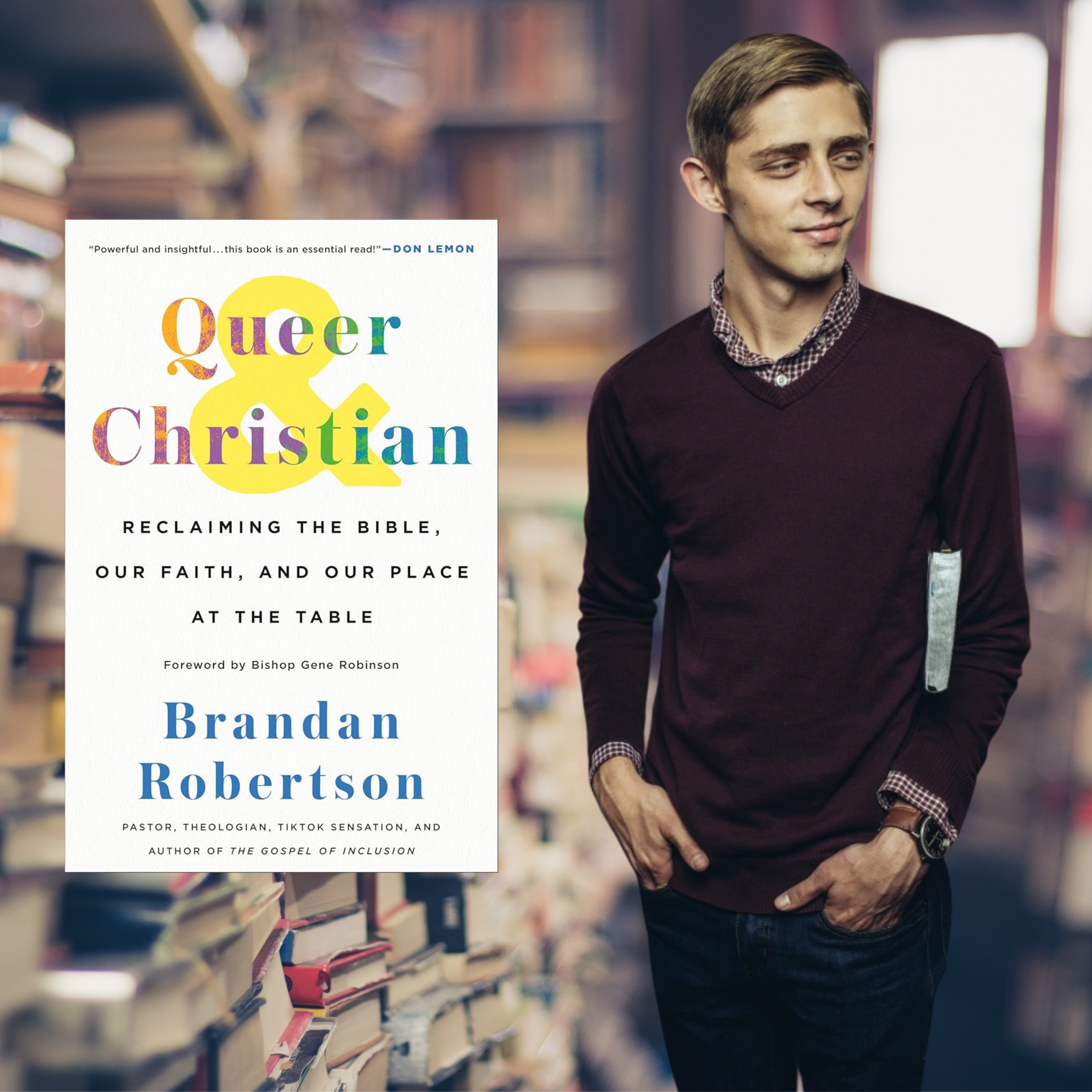
[email protected] calendar to sign up this month, our host, Jason Coker, along with other book club members, sat down with Reverend Brandon Robertson, the acclaimed author, activist, public theologian, and author of Queer and Christian. They discuss how to celebrate queer faith, reclaim the Bible, and fully embrace Jesus's radical message of unconditional inclusion. So settle in and enjoy this thoughtful conversation between the TCT Book Club and Reverend Brandon Robertson right here on the Collective table.
[00:01:03] Speaker B: Foreign
[00:01:06] Speaker C: it's my pleasure to formally welcome Brandon Robertson to our book club Collective Table podcast. Here Reverend Brandon Robertson is. This is his. His formal bio, by the way, is an author, activist, and theologian known as the TikTok Pastor. He hosts the Faith for the Rest of Us podcast and has authored or contributed to 26 books, including the Indies Book of the Year finalist, True Inclusion. His work appears in Time, the Huffington Post, and the Washington Post. Named in Rolling Stone's 2021 hot list. He speaks at venues like the White House and Oxford University and is a champion for LGBTQ rights. He's pursuing a PhD in biblical studies at Drew University. You still working on that, Brandon?
[00:01:55] Speaker B: Still working on it.
[00:01:56] Speaker C: Okay, fantastic.
In addition to the formal bio, I'll just add that it doesn't say here on the bio that Bre and actually pastored here in San Diego county for a few years down at Mission Gathering Christian Church, and it was a pleasure to have him here in District 8 with the disciples of Christ.
And I've had Brandon on other podcasts and Zoom calls before, so I always appreciate his willingness to jump in and have a conversation with us and really grateful for his work. Welcome, Brandon. We're really glad to have you.
[00:02:31] Speaker B: Yeah, thank you so much again. And I've loved and admired the work of your community for a long time. So it's always a joy to get to be back with you all.
[00:02:38] Speaker C: Oh, my gosh, that's so nice of you to say. We can end the call right now. I feel great, obviously. Just kidding. So I'd love to read this Excerpt from Queer and Christian if I could. It feels to me, Brandon, a little bit like Queer and Christian is the culmination and maybe even like clarification of a lot of the work that you did before this, a lot of the writing that you did before. And so I really appreciate that. It really felt like you pulled together a lot of threads in a way that is just really powerfully stated. And so I love this passage. If I could read just for the rest of us.
You write, to be queer is holy. It affirms that God doesn't make mistakes, that our unique expression reflects divine creativity, creativity. It refuses to blaspheme our Creator by trying to limit or suppress the image of God within us. In this broad sense, queerness is a calling every person should embrace.
As Paul wrote, do not be conformed to this world, but be transformed by the renewing of your mind. Romans 12:2. To be queer is to see beyond the masks and roles that hide our light.
Bell hooks defines queerness as, quote, being at odds with everything around it, and that feels right. We live in a world built by systems designed to benefit a few. What's accepted as normal has always been constructed and can be changed today. As awareness of diversity grows, more people recognize that demonizing difference harms us all. Movements of resistance have queered our societies for the common good by questioning and challenging these false normals. And I love, of course, that you took the opportunity to quote bell hooks. I think she is incredible, integral to this conversation. But I also love, like, how bold you are in saying we should all aspire to be queer, in a sense. And right after this, I don't read this. Didn't read this part today, but right after this, I think it's right after, maybe right before, you talked about how queer was originally a slur.
And so I wonder if you could speak a little bit to that. Like, how did you go from, you know, being a closeted gay man at Moody Bible College, of all places, and then coming to terms with your own sexuality, your own queerness? And then how did that transition happen where you appropriated queer as a point of pride?
[00:05:24] Speaker B: Thank you so much.
And, yeah, I mean, I think one of the things I've seen, not just with this book, but since I've been doing this work, is I think I say this in the book, but one of the first times I used queer publicly, I was speaking in rural England, and when I said the word queer out loud, there were audible gasps in the audience.
And as I've done this work now for a while, I've recognized that there's a real generational divide, primarily about the word queer. Bishop Gene Robinson talks about it in the opening of the book as well, that for a particular generation, queer was a slur word, and it was primarily a word folks didn't want to be associated with.
But at the same time, even back in the 50s, 60s, and 70s, there were folks using the word queer not primarily as a sexual description, sexuality description, but as a political ideology that kind of aligns with what I quote bell hooks as saying, this posture of resistance to norms.
And so, you know, it took me a long time to want to come to terms with the word gay on my own journey. I certainly didn't use that word until a few years after I had left Moody Bible Institute. But really, those four years at Moody were formative for me because it allowed me to both have a space to go deeply into the Bible and wrestle with what the scholarship actually says. Because the truth is, even on the conservative side of this conversation, there's an admission that things are not as clear in Scripture as folks make it sound.
So that started raising questions for me. And of course, I was also in downtown Chicago, which I always say, Moody has a really bad setup for a fundamentalist school, in the sense that if you put a fundamentalist school in the middle of one of the biggest cities in the country, as soon as students walk off the campus, they're confronted with things that challenge the theology they're being taught within the four walls of the institution. And so I kept finding God in Chicago in all the places my theology said God wasn't supposed to be. And so that started a whole another deconstruction process, apart from my own wrestling with sexuality.
And I had a very similar journey to a lot of folks. When I initially came out, I used bisexuality, which I recognize now is not.
I think it's a very easy way to kind of erase real bi people by queer people using bisexuality as a stepping stone towards coming out. But that was what happened on my journey.
And then before I came to the word gay, I actually started really resonating with the word queer. And the reason is because queer feels like a better descriptor for me. It encapsulates my gay sexuality, but it also encapsulates my spiritual posture and my political posture, that of wanting to challenge and question norms.
One of the subtexts of this book is a questioning of this idea of orthodoxy. For instance, even progressives tend to see orthodoxy as something that we don't want to touch too much we don't want to mess with it too much, but orthodoxy itself is a system set up by human beings who gathered in councils and debated and decided, sometimes by vote, what the doctrine of Christianity would be. And I think Jesus's posture in his own religious tradition was one of constantly questioning, constantly pushing against the norms and traditions. And to me, that's what queerness is.
And so in this book, I hope, one, I empower a generation of people that do resonate with the word queer as a sexual or gender identity label to see that as compatible with Christianity. But as you said earlier, I also want to invite non LGBT people to see queering as a posture that is fundamental to the Christian faith and is fundamental to who Jesus was and how he did his ministry in the world.
[00:09:32] Speaker C: Yeah, I appreciate that perspective. It's important, I think, for us to remember that what the Holy Spirit is doing, for example, in the Book of Acts, is transgressive. And so coming to terms with how God is the one who is constantly pushing our boundaries, stretching our comfort zone, helps us, I think, to be a little bit more open, open to the possibilities what the Spirit of God is doing. And I think you appropriating or naming the appropriation of the term queer is really helpful to that. We have a. A group, all the people on the call here will know this, but we have a team, a ministry team here at the church that's made up of LGBTQ persons and allies. And several years ago, when that team first started, I want to say about seven years ago, I said, hey, you guys should come up with a mission statement and a name. You should call yourself something. And much to my surprise, they came up with the term Queer Committee.
And I thought, okay, sounds good. We'll call it the Queer Committee.
But what's interesting is over the years, a lot of people have come to that group and said, hey, I really love this. I want to be a part of this, but, boy, I'm a little older. And that term still feels uncomfortable. And, you know, to their credit, they, you know, have been gracious and open minded about it, but it's still something that we see even in our congregation, that you can see the woundedness that sometimes older LGBTQ people carry with them when they. When they hear that term.
I also really appreciate it, Brandon, that you brought up the issue of biblical interpretation and how even conservative scholars, or at least conservative scholars who are intellectually honest, I would say, are willing to admit that the Bible and how it speaks to issues that are adjacent to or relevant to LGBTQ issues isn't as clear as perhaps they wish it was, or we have pretended that it is. And so I wanted to ask you a question about that. Just given how the Bible has been used so pervasively as a weapon against the queer community and has been used to incite bigotry and hatred and even violence against LGBTQ people, how do you think progressive churches or liberationist oriented churches like ours can sort of toe that line between confronting those harms and those interpretations on the one hand, but on the other hand, still upholding that Scripture is sacred to our tradition? That's a tension we.
We really feel in a church like ours. You know, kind of like going back to that old restorationist movement slogan, no creed but Christ, no book but the Bible, no law but love. We have that no book but the Bible part in the middle, and that still feels uncomfortable at times because we're constantly critiquing that book. So I wonder, what's your insight into how a church like ours or other churches like ours could best lean into that tension?
[00:12:41] Speaker B: Totally, yeah. I mean, this is one of the other subtexts that I weave throughout the book. When I was writing this, I was actually not thinking of queer Christians. I wasn't even thinking of Christians at all. I was thinking of the queer people that I meet here in New York City that have nothing to do with religion, but come from a Christian background and have a posture of why would we even care about what the Bible says? It's a 4,000 year old book from the Bronze Age. Let's leave it behind.
And I get that impulse. And I see that in a lot of progressive Christians. There's stuff in the Bible that we can't reinterpret or explain away. It's just bad stuff.
And yet the first reason I think it's so essential for us to not give up the Bible and in fact to deepen our engagement with it is political and social.
The Bible is still the most powerful book in the world, and it will be for the rest of all of our lives and for generations to come.
Billions of people around the world look at the Bible as a source of authority.
Millions of lawmakers and public officials use the Bible, not just in the United States, but in countries all around the world as justification for laws. I think back to the Uganda anti Gay bill, that was a few years ago, quotes Leviticus in its legislation which calls for the death penalty for homosexuality. So the Bible is deeply influential, even if it moves from its central place of authority in our own spiritual lives.
It still is influential. And it's important that we know how to engage with it in a robust, in a scholarly, in a progressive way that reclaims it. Because when we simply say, screw the Bible, we're conceding the most powerful book in the world to the hands of those who are using it to do a great deal of harm.
The other thing is, I've also learned that we have this image of conservative or traditional Christians as being deeply biblical.
But in the past 10 years, and especially in my PhD studies in biblical Studies, I've recognized how biblically illiterate I was as a conservative Christian and how much conservative Christian preaching is actually biblically illiterate. It's taking passages of the Bible and using them devotionally, but not from a rigorous scholarly or theological lens. They're not doing the work to know what the text actually meant to its original audiences. They're not studying the culture, context, and language of the Bible.
And I think when you begin to do that, the Bible becomes an actually pretty fun book to engage with.
I've been so influenced here in New York City. I go to a queer Jewish synagogue called Lab Shul. Oh, I love that.
[00:15:30] Speaker A: Yeah.
[00:15:31] Speaker B: And it's been so incredible to watch how Jewish folks engage with Scripture.
And pretty much across Jewish traditions, they've always had this dynamic relationship with the Bible where it is not the inerrant word of God, but something with which we argue it is the library of texts from our ancestors and forerunners in the faith that has great wisdom but also has a multitude of interpretations. And if you look at a book like the Talmud, which is like, second only to the Bible in Jewish Scripture, it's a book where rabbis debated every verse of the Bible, had 14 different interpretations of every little jot and tittle of Scripture, and. And never said one was right or one was wrong, but left the tension with the multitude of interpretations.
If Christians were given permission to wrestle with the Bible not as the final authority, but as a conversation partner, where we respect it as wisdom from our forerunners in the faith, but also recognize that the Spirit of God is still speaking, that frees us to engage the Bible dynamically to reclaim the wisdom where it is helpful, but also to say this word was good for the time that it was given, what is the Spirit speaking to us today?
And the last thing I'll say here is that this is actually what all Christians already do, even conservative Christians, although many of them are reverting to terribly racist theology. A vast majority of evangelicals were influenced by the abolitionist movement, which said yes, Paul says, slaves, obey your masters, but we don't think that that's ethical or moral. We don't think that's where the spirit of God is calling us. We think Jesus's example surpasses that command from Paul. And abolitionists evolved their theology, interpretation of scripture to move beyond the clear meaning of what Paul says, to embrace a more robust, I would say, progressive, liberating theology.
We all do that. Christians have always done that. And progressives just need to get better at owning that we are biblical, we care about the Bible, but that the Bible is our conversation partner rather than the final word on all matters of faith and ethics, because it simply can't be as a 35 year, 3500 year old book.
[00:18:01] Speaker C: Yeah, I just so appreciate you unpacking all of that. And people who are part of our church, I'm sure, will recognize a lot of what you said and what I'm constantly saying here about having a discourse and a dialogue and even a debate with scripture and that it teaches us how to do that so that we can do that with our. With. With our own culture, with our own laws, with our own community of faith. And so I really appreciate that perspective. It. It occurs to me that, like you said, Christians already do this, and I think that's true. I think that what oftentimes fundamentalists or authoritarian Christians do is they outsource the emotional labor of that conflict to their pastor or their priest or, you know, the head of their denomination or whoever it might be, so that they're relieved of the.
The, again, the emotional labor, the tension of having to decide, like the. The responsibility of freedom, having to decide, where do I stand?
And now, like, how do I make a case for where I stand? Like, that sounds like a lot of work. And it's also potentially a lot of conflicts, right? Both with yourself and with others in your community or with our spiritual ancestors who we might disagree with.
And I. And I think, like, my sense is that we just don't like that. Like, we don't.
That tension. And that labor.
And this, I think, is relevant to what you write about and also who you are, because I think LGBTQ Christians know that emotional labor really well, because as they read Scripture and as they encounter things that feel like condemnation to them or they encounter passages that were used, weaponized against them, they're doing that very real work, that very real labor of having to work through it.
And the rest of us often don't have to do that. Right? Like, I don't have to do that. The the way that the Bible has been interpreted and the way, you know, Western Christianity has been constructed is literally for people like me.
And so I'm off the hook in a lot of ways. And so I'm wondering. I'm working up to another question here. So I'm sorry it's taken so long, but I'm wondering how you have seen churches who embrace that, Embrace that discourse, that dialogue, that debate with scripture around these kinds of issues. How you've seen them, like, make that emotional labor a little bit safer, a little bit easier to enter into without it feeling like this incredibly dangerous or incredibly fraught enterprise.
How have you seen churches equip people or maybe create spaces where it's safer to do that vulnerable work? Does that question make sense?
[00:20:57] Speaker B: Yeah, I mean, I think the answer to that question is what you're already doing in many ways. But I want to reflect on some of what you said in the lead up to that is I'm writing a book right now on how to heal from toxic high control religion. And it goes right to what you were saying, that I have a lot more empathy now on this side of my deconstruction for conservative Christians, because like you said, so many of us live such chaotic lives in such a chaotic world that it is really nice to go to a church where a guy in the front tells you this is the way it is.
And you don't have to think, you don't have to, you just obey. And it's not even to belittle them. Like, I think many of us, if we came from conservative backgrounds, were there at some point in our lives.
It's also why I think progressive churches, progressive megachurches, don't really exist. Because when we enter into this posture of Christianity, we're committing to discomfort, we're committing to not knowing, we're committing to having to wrestle and debate and be unsettled in our faith.
And it's also very interesting that I see from some of the most liberal atheistic LGBT people, I'm always surprised when I get comments on my videos and things like that. And they say the same thing conservatives say to me, you're just misinterpreting the Bible. You're twisting it to fit your own desires. Like, that's not what the Bible says.
Which goes back kind of to the last question in the sense that the conservatives have done a really good job of convincing everyone that their interpretation and way of engaging with the Bible is the way of engaging with the Bible. And, and anybody who's doing it differently is twisting it, reading into it, changing it. You even see this from folks like Richard Dawkins, who constantly critiques Christianity. But most of us would agree on this call the Christianity he's critiquing. We don't believe in either. But he doesn't want to acknowledge that there's a richer, deeper tradition, other ways of seeing Christianity.
So all of that is to say, I think progressive communities need to have grace for the folks that come through our doors, that are leaving or escaping conservative religion, or have that in their background. Because a lot of folks are going to be triggered when they see us doing open interpretation or wrestling with the text, even if they don't believe that the Bible is the word of God, because of how they've been taught to view this text and engage with it.
But at the same time, part of what I do in this book is something that 10 years ago would have made me roll my eyes so hard. I have that whole section of scripture where I, I look at or of this book where I look at the queer saints of Scripture.
What that the purpose of that is to introduce queer biblical interpretation, which is in the same lineage of black liberation theology, feminist interpretation, womanist interpretation.
All of that is how we've Christians have always, again, engaged the text. You begin with the lens that you have in your incarnate experience and have permission to read the Bible from your experience and see what uniquely pops out to you.
Progressive church is my hope. I don't think we actually do this very well at saying to the diverse people in our communities, your lens is a source of authority, your experience is valid. And when you read scripture as a woman, or you read the scripture as a trans person, or you read the scripture as a person of color, the stories are going to have different meanings and different lessons.
And when we empower people to have that authority and to know that their own life experience and lens is a valid authority, that's when the Bible becomes a living text in our communities and become enriched because you're challenged by what your black neighbor in the pew sees in the text and what your queer neighbor in the pew sees in the text that are fundamentally different, looking at the same stories, but both have a valid lesson for us. And so it's about making that space, giving people the authority back to engage the text from their own incarnated experience, while also having grace, knowing that even progressive people, even LGBT people, have assumptions about the Bible that are going to continually trip them up for a while until they get comfortable reinterpreting what the Bible Fundamentally, is.
[00:25:32] Speaker C: Yeah, well, and I really appreciate that you reference liberationist theologians, womanist theologians, feminist theologians, because that's where, you know, so much generative work has been done theologically to open up Scripture to those perspectives. And, of course, those. I think one of the things that's most powerful, especially about womanist writers, is that what they're doing is midrash, which, of course, we learn from the Jewish community and from the Jewish tradition. And when we're exposed to that. I know that in my case, like, when I was first exposed to Jewish midrash and then womanist midrash, like, I was shocked to discover just how incredibly creative and expansive readings of Scripture can be.
However, like, the flip side of that is that also can play right into the accusations of fundamentalists, you know, who would say, no, you're not allowed to interpret Scripture that way. You're not allowed to read it that way.
And so I wonder, like, for you, what is the.
This is not a question I sent you in advance, so I apologize. But for you, in that sort of, like, tension between more rigid interpreters and more. I mean, I hate to use this word, but more liberal interpreters. Right. More of, you know, read between the lines. Midrash, expansive approach to Scripture versus a very constraining approach to Scripture. In that tension, what do you think validates or.
Or confirms what are good interpretations and applications? Like, how. How do we. How do we validate what we believe it might say or speak to us, even from our lived experience?
[00:27:32] Speaker B: Yeah, I mean, I think many of us still carry assumptions about what the Bible is and even what God expects from us that need to be critically examined. Right. Because when we engage the Bible, there are two ways of engaging the Bible. I'll say it this way. There is the historical critical lens, which is actually my favorite lens. And it's the lens of most biblical scholars, which is really digging in and doing the work and asking, what did the text mean to the original audience? What was the author intending? None of that is ever precise because there's no way to ever know what an ancient author precisely meant about anything in any book. But you do the work that gets you very close, and you can say, here's the range of meanings of this text or this word based on historical context.
Conservatives claim to do that.
But 99% of the time, for a vast majority of the controversial issues that we all are divided about, conservative scholars, like progressive scholars, begin with what they want to justify in the text, and then they defy it and claim it's historical. What I love about people like, and I'm sure many of you will be familiar, people like Dan McLellan and some of these other Bible scholars on the Internet, they're really democratizing historical critical scholarship, which is to say they're trying to be objective in understanding historically what the text meant and then leave up to you to determine your beliefs. That's how good biblical scholarship should work.
But you're right that the conservative will always look, or the fundamentalists will always look at anything other than beginning with a creed or a systematic theology and justifying that in Scripture as unfaithful.
Because the goal for a conservative Christian is to believe the right things in order to gain salvation. They would never say it that way, but that is practically how conservative or orthodox Christianity works out. Unless you believe the right doctrines, you're not truly saved and you will go to hell.
The progressive and dare I say historic Christian faith has always held that it was not doctrine first that saves us.
And when you make that shift, when you engage the Bible, you stop asking, is this doctrinally right? Is this interpretation leading me to. Towards the objective truth, whatever that means. And the question becomes, is this leading me to be more Christlike? Is it leading me to bear the fruit of the Spirit? It's this a loving interpretation.
[00:30:26] Speaker C: Yeah.
[00:30:27] Speaker B: And the last thing I'll say is, as you already mentioned, this is a deeply Jewish way of engaging with the text.
[00:30:33] Speaker C: Yeah.
[00:30:34] Speaker B: Jesus does this all the time. And I constantly, every week I'm quoting Jesus when he says, you have heard it said, quotes the Hebrew Bible, and then says, but I say unto you and gives a new and better commandment that that is incompatible with the previous commandment. An eye for an eye and a tooth for a tooth and turn the other cheek are fundamentally different commands. But Jesus didn't have a problem looking at Deuteronomy and saying, yes, it says an eye for an eye and a tooth for a tooth. And I believe God is calling us towards a higher and better standard.
So all of that is to say, for in my own journey, I've had to give up trying to convince traditionalists that I'm more biblical than them, because from their paradigm, any kind of scholarship we're doing, any kind of interpretation we're doing, because it's not beginning with creeds and doctrine is going to be unbiblical, twisting Scripture.
But we've got to be confident in the fact that we are doing what our tradition and what the broader tradition has done for thousands of years.
And it leads towards, again, a deeper love for the Bible, I believe, because if you can wrestle with and engage with and get creative with the Bible goodness, it actually becomes devotionally fun to engage with rather than needing to find the objective truth or else you're going to be separated from God for eternity.
[00:31:59] Speaker C: Like, yeah, well, and you did point, I think, very helpfully you pointed to, at least for you, how you are validating the conclusions of scripture that you might come to when you say, at least this is what I heard you say. When you say, is it Christlike, Is it loving? Does it reflect the fruit of the spirit?
These are, of course subjective. They have to be like, we, we can only be subjective about whether or not, you know, our outcome is loving.
But that gives us an outcome to point to, to say, well, you know, if your interpretation of this passage means this and my interpretation means that the question is, which is producing the best fruit, this is what Jesus, I would argue, means when he says, you know, a good tree from a bad tree bites fruit. Right? Over and over and over again, we see, you know, the outcomes being pointed out like that.
[00:32:55] Speaker D: Hello, Collective Table listeners, it's CJ again. A lot of people out there might not realize that this podcast is part of a real life faith community. The Collective Table podcast is a production of the Oceanside Sanctuary, a progressive Christian community whose mission is to foster collective expressions of inclusion, inspiring and impactful Christian spirituality wherever it is needed. And as a 501c3 non profit organization, that mission is only possible because of the generosity of people just like you. So if you believe in what we are doing, if you benefit from this mission, please Visit
[email protected] Give to become a supporter today. Together we can keep building communities of love and liberation.
[00:33:54] Speaker C: So another question that I have for you, I'd love to get your thoughts on, is how, how long has it been since you were pastoring at mission gathering? Remind me, when, what years were you there?
[00:34:04] Speaker B: 2017 to 2021 maybe.
[00:34:08] Speaker C: Right, right, right. So you were there like right after the first election of Trump.
And like, when I, when I reflect on, like, so it's 2026, right? When I reflect on 10 years ago, like how I was thinking about these issues 10 years ago and I don't know about you, but if you had asked me 10 years ago what I think is going on with queer inclusion, LGBTQ inclusion and Christianity, I would have said to you, oh, it's definitely getting better. Like I, I might have even said, this is inevitable. Right? Like, more and more evangelical churches are becoming open and Affirming.
There were really good and interesting case studies in churches that did make that switch. More and more evangelical pastors were making that switch.
And then something really changed, Right? Like, as a culture, we really doubled down on authoritarianism. We really doubled down on anti lgbtq, especially anti trans rhetoric and hate.
And it's been harder for me to be an optimist over the past four or five years.
And in that time, I gotta say, like, some of my favorite progressive Christian churches in the United States, the churches that I looked to and thought, oh, one day, I hope the Oceanside Sanctuary is, you know, like that.
A lot of those churches have shut their doors. You know, they've really taken a beating.
And so I'm wondering, what's your sense of the future trajectory of this? Are you still optimistic? Are you having a harder time being optimistic? Do you feel the cultural winds shifting back in the direction of people maybe shifting their minds around this?
What's your take on that?
[00:36:03] Speaker B: Yeah, I think. I believe two things are true, and neither one of these will be revolutionary. But I think, one, I do believe the more our society deconstructs, and I mean democratically, in every other way, I do think there will be a need and a return towards gathering, towards religious community in general. And I think that's conservative and progressive.
And so I do think in the future, we've never been more interconnected than we are now, but we've also never been more isolated. The studies are clear about that.
So I think just the idea of religious community, a place where you gather every week to be with people who have the same values of you, will have a renaissance in the future. So I'm not pessimistic in that I think progressive Christian churches are all going to die and clear out.
I do think we were talking about this 10 years ago. We probably had conversations about this, that we need to rethink what our denominations mean and how we use our resources and all of that. So that's one. One side on the practical church side, as far as the issues go, you're exactly right. Not just have we. Not only have we backtracked on LGBT trans issues in particular, but people like Douglas Wilson, who is a pastor from Idaho, who's now Pete Hegseth, pastor in D.C.
preaches racial segregation and Christian nationalism in its most extreme forms, calling for the death penalty for homosexuality and things like that. And that's being validated by the most powerful people in our country.
That's shocking to us. It should be. But it's also not surprising when you take a broad view of history. History is cyclical.
And whenever there's a great forward push, there's always an equal and opposite push backwards. And then society tends to move slowly, less dramatically, but forward.
And we see this with racial justice and the way our country has constantly done this. But we have indeed made progress, and I do think we have made progress on the LGBT issue in the church. I say this on every stop on my tour. I did last year.
I wanted to remind people that every major mainline denomination in this country is fully affirming of LGBT people at the nominational level, at least.
That's insane. And the fact that if you go out on the street right now and ask your average person, are most Christians in this country LGBT inclusive? People would say, hell, no, that's not where Christianity is at. And yet, numerically, or at least institutionally, the vast majority of Christians are represented by LGBT inclusive denominations.
But I also think the Roman Catholic Church is really the bellwether that we should all be looking at, because Protestant Christianity can change quickly, but it can also revert quickly.
Roman Catholic Church takes thousands of years to move 1cm on any social issue.
And I think that's. Honestly, we've seen great progress with Francis and Leo on LGBT issues, but no progress on actually changing doctrine. So do I think the broad Christian church around the world is going to become LGBT inclusive in my lifetime? No.
But do I think we're going to see the slow and steady churning forward of more churches coming to this posture and churches like the ones we pastor? I pastor a church here in New York that's 30 people on Sundays, but we're figuring out what it looks like to embody a progressive faith outside of the traditional structure of church. And I know Oceanside Sanctuary has been doing that for a long time, so.
Don't know if I answered the question at all.
That's a series of thoughts.
[00:40:06] Speaker C: Yeah, no, I mean, I think your historical summary is. Is helpful, and it's hopeful. And I. And I agree. I think that we can't expect history to move, you know, like a pendulum. You know, there's a dialectic to history, and I think hopefully we'll live long enough to see it swing back in the other direction again.
But it sure is frustrating in the meantime and that. And it really is dark days right now, not just around LGBTQ issues, but around really every social issue, every social problem that seems like we've made some progress on. And now, you know, as a culture, we're doubling down or tripling down on, you Know, erasing, for example, you know, statues and memorials to, you know, civil rights heroes. Right. For example. And so that is. It's hard and it's discouraging, but what I'm hearing you say is to have a view for the long horizon ahead because, you know, it will swing back eventually.
Let me ask you this question, Brandon, if I could. And I. And I hope this isn't, like, you know, too much of sort of a hot topic, but, like, I think a lot of people, maybe not people on this call, but probably some people in our congregation and certainly a lot of people in the church at large would say, you don't know about this idea of, like, you know, taking on queerness as a posture that we should embrace.
Like, how far does that go? Like, what are the limits of that? Like, you know, shouldn't some things just be considered normal? And, you know, I'll give you a good example of this. You know, we are a queer celebrating church, not just a welcoming church, not just an affirming church, but, like, we really try to celebrate and center queer people and queer relationships as good, if they are producing good fruit, just like anybody else.
[00:42:14] Speaker B: Right.
[00:42:14] Speaker C: Like, that's our standard.
But just this weekend, I had somebody reach out who's interested in having somebody marry them, who are a gay couple and they are in a poly relationship. And this is a transgressive, like, approach to LGBTQ relationships that's become very common, actually, in our culture. Like, it. It's not really unusual to know somebody who's in a polycule, you know, for example, or has done that at some point in their lives. And more and more people are.
Because it's becoming more culturally normal. More and more people are being open about that. And so this couple that was looking for a progressive pastor to marry them is being commendably, very upfront about the fact that this is their sexual ethic in their relationship.
And I think that that is just a reflection of our culture around us. Right.
And so a lot of people, I think, would be really frightened by that, like, really defensive about monogamy, for example.
And.
And I know plenty of LGBTQ theologians who criticize progressive churches for being LGBTQ affirming, but is still really upholding a kind of heteronormativity. Right. Like, it's okay for you to be gay as long as you look a lot like, you know, hetero couples. And so if I could. Let me ask you that question, Brandon. Like, how far does queerness go? How far does transgressiveness go in the Church. Like, what's the church's role in accommodating that?
[00:43:58] Speaker B: Yeah, no, it's such a good question and it's one that I've wrestled with really substantially. I think the question, the chapter in this book on sexual ethics was one that I deleted and rewrote about literally 15 times because I take seriously that I, I am a pastor and I do have some sense of authority and I don't want to just write something that leads people into things that are harmful.
But I also think that a lot of progressives, we still function in a paradigm that is fundamentally fear based. Right?
I begin the book by quoting first John, which is the kind of undergirding theme of all of my theology. God is love and perfect love casts out all fear because fear has to do with punishment. If our theology and our ethics are not fear based, then there technically are no boundaries and borders. Years ago, maybe 15 years ago, Doug Padgett talked about progressive churches moving from boundaried sets of ethics to value centered or bundled ethics, meaning conservative churches set boundaries. These are the things you have to believe, you have to do. You cannot cross these lines or you're not part of our community.
Progressive churches tend to say, here are the values that we all hold dear and we circle around those, but the way that those are lived out will look vastly different for each person.
When it comes to sexual ethics in particular, I find great wisdom in Paul's argument with himself in First Corinthians when he says everything is permissible, but not everything is beneficial.
Paul's literally responding to a couple different ethical debates taking place in Corinth. Christians are wondering what is right and what is wrong.
And Paul very wisely says none of it is right or wrong, all of it's okay. And he recenters the ethical debate on but is it beneficial?
Is it moving you towards wholeness? Is it moving your community towards wholeness? Is it moving if we're talking about sex or relationship ethics, is it moving the person you're engaged with or persons you're engaged with towards wholeness?
And to me, that has been a really helpful reframe.
It moves both my own ethics, but also people I'm pastoring out of the fear based.
I can't give you right or wrong. I can't determine if a polyamorous relationship is right for each person on this call or if it's wrong for each person on this call. For some of us it's right. For some of us it's wrong. But the question is, is this relationship moving you towards wholeness, Is it benefiting? Is it not causing harm?
And so I have used that pastorally and I use that as a broad sexual ethic. I think it even helps straight folks because one of the things we've seen in the evangelical world in particular, and forgive me for ripping on them, but they are my people, so I feel like I have a right to point at them a little bit.
But they've preached a sexual ethic for so long that virtually no one actually lives.
And this is why we're seeing literally every year a megachurch pastor or a magazine editor or whatever, falling from grace, so to speak, because they couldn't live out this black and white ethic.
And I the it's not to justify and say that what they do if they cheat on a spouse or whatever is good or bad.
The question is if they were able to be honest about their sexual ethics and, and not have to fit within a rigid boundary set, but really ask what is the most loving thing, what is beneficial, moving us towards wholeness thing, could some of these relationships have looked differently and not ended up in the harmful downfalls that they ended up in?
I think the whole idea of queerness is that when we're forced to conform, that is when danger happens because we all start living in ways that are inauthentic, we all start lying.
That's one of the big things I talk about in this book. Queer people are taught to lie about who we are in the world in order to be seen as righteous and holy.
Queerness is meant to explode that and say, there is no place for lies. There's only place for authenticity. And there's only place for asking, does this move me towards wholeness and love? And if that's the ethic, then again, we have to be comfortable with people in our churches that might be polyamorous. They might be committed asexuals and never want a relationship or have sexual interest. They may want a monogamous relationship where they wait until marriage to have sex. All of that has a space, as long as it's moving folks towards wholeness.
[00:48:56] Speaker C: Yeah, I so appreciate you centering the subject of harm because we just had a leadership training on Saturday where I talked a lot about that, so you make me sound really smart when you say that, but.
Yeah, but. But I do also really appreciate you quoting Paul in First Corinthians in that passage, because that passage is often, I think, cynically interpreted to be Paul sort of quoting a slogan ironically and then. And then arguing against it essentially.
And I don't think that's a helpful interpretation. I mean, I mean, I think there's an argument to be made for it for sure.
But, but if you interpret it the way that you have, where Paul is essentially centering harm, not arbitrary boundaries or arbitrary behaviors, then I think it makes more sense of Paul. Like later in that same letter, right? In chapter eight and chapter 10, he's talking about whether or not Christians should eat food sacrifice to idols. And he does the exact same, in my opinion, does the exact same thing when he says, hey, look, we all know that these gods aren't real, but other people don't know that.
So when you're around them, maybe you shouldn't eat that food sacrifice to idols because you'd be harming them. So again, Paul in his ethics centers, harm, right? So first, is this harmful to you? Sure it's beneficial or sure it's allowed, but is it good for you? And then later in that same letter, yes, you have the freedom to eat whatever food you want, including food sacrifice to idols. But are you harming others by doing it? Are you wounding their conscience?
And so again, I think Paul has this incredibly practical harm based ethic that I think we could learn so much from if we were willing to apply that to our own cultural context.
I just really appreciate you bringing that up. We did have a couple questions popped in the chat. I'd love to share those. The first is Leanne has a great question. This is such a Leanne question. So I appreciate this.
Has Brandon been surprised by anyone in his past coming to him to encourage him now if they were not supportive before? So leave it to Leanne to ask a pastoral question.
[00:51:14] Speaker B: Yeah, thank you for that one. And I, I'll tell you a brief story.
I grew up, I got saved in a fundamentalist church, but I very quickly, within a few years, ended up in an evangelical mega church. And, and my pastor, a guy named Dr. David Anderson, mentored me throughout high school. They paid for me to go to college. They really were training me up to become one of their leaders in that church. And then I turned out to be gay and progressive and that didn't really work out.
But what I will say is, again, I'm with so many people and I spent so much of the last decade feeling really hurt and angry and not having room for anybody who didn't agree, especially on LGBT issues, but on all the issues that I've changed my mind on.
But my pastor, Dr. David Anderson, from childhood has remained so consistent in not just pastorally, you know, the icky Pastor, like, I'm praying for you. How are you doing? I'm praying for you. But like, actually, let's talk about life. Let's get to know one another. Let me know what life is like for you now.
And every year he ends up preaching some sort of sermon on sexual ethics. And every year he calls me the night before, says this is what I'm going to say. And he allows me to help him nuance it and push back on things. And it's just been really encouraging to see a bonafide evangelical mega church pastor who's actually listening, learning, evolving. He's not where I want him to be. I don't endorse any of the messages he's preached in the past few years, years. But I have seen the evolution and he has been committed to relationship above rightness and wrongness.
And I actually think there are a lot more people like that out there in America right now. But fear makes us afraid to be in relationship with one another.
And I think if we're going to have a country and if we're going to make progress, all sides of these questions do need to have the ability to, to enter into good faith relationship with people who see the world dramatically differently and not begin with progressives are false teachers and antichrists, or conservatives are bigots and racists and homophobes.
And so I'm careful where I say that because there's also another side to that of sometimes we do need a break off relationship and sometimes we can't just let things go. But in my own life, I've been really blessed to have a conservative evangelical be with me for 20 years now throughout all of my journey.
[00:53:49] Speaker C: That's wonderful.
[00:53:50] Speaker B: Thank you for that.
[00:53:51] Speaker C: It gives me a lot of hope.
And thank you for your braveness for writing this book with all the details, with all of the, the way you addressed everything so specifically in my reading anyway, and, and yeah, I'm very impressed.
[00:54:10] Speaker B: Thank you for that. Thank you so much.
[00:54:15] Speaker C: I apologize, Leanne, I should have just let you ask the question yourself. But like, you know, I'm so busy. Talk, talk, talking. Like I, I didn't think about that. On that note, Amanda has a question too. Amanda, would you like to ask yourself or would you like me to read what you wrote?
[00:54:32] Speaker E: It really doesn't matter.
[00:54:34] Speaker C: Go ahead.
[00:54:35] Speaker E: I just asked. We left a pretty conservative evangelical church, but we stayed as long as we did because we were hoping, praying we could help steer things in a more progressive way and kept hitting the ceiling. So we felt like we had to leave, but we left a lot of people behind.
So what would your encouragement, advice, recommendation be for those that are staying in those environments for the sole purpose of trying to bring affirming culture affirming voices into those spaces?
[00:55:09] Speaker C: Yeah.
[00:55:10] Speaker B: Thank you for that.
I. I've thought a lot about this because that was the posture I took when I first came out. Even at the beginning of my time at mission gathering, we were still calling ourselves evangelicals, and we were still, like, committed to being in that space. Owning those labels, I think it is a calling.
I think a very unique kind of person is able to stay in a space that has teaching that we might consider toxic or wrong.
I think such people need to have done a lot of the psychological and spiritual healing to be able to protect themselves and shield themselves from harm in order to stay in those spaces and make the change, because it's a long process. The vast majority of churches that do move on these issues take decades of small conversations before they get to a place where they actually make a decision.
And so the first thing I want to say is we should bless the people that feel called to stay in those environments and have those conversations and make small change.
But we also cannot beat up ourselves for not wanting to stay in those spaces. Because when the church becomes a place where you need to be, where you exist there in order to make it change into something else, it's no longer your spiritual community. It is a ministry, it is a calling. It is a work that you are doing. And so you're not getting the spiritual nourishment, the spiritual, the communal nourishment.
And so I just want to say, I think it's really good that progressive spaces like this exist where folks from those places can go and find real community and spiritual nourishment.
And the third category is the folks that come to a church like this. And the churches I pastor but still maintain relationship with the people back in those other communities. Not everyone can do that, and it's not healthy and good for a lot of folks to do that, but it is. The only way we change people's hearts and minds is whether they see us as queer people or progressive people or deconstructive people.
If they see us continue to be in relationship with them, continue to have a robust faith, continue to be growing more Christlike and more loving, despite not having the same beliefs anymore or being in the same kind of community, that is what actually opens people's hearts and minds far more than debating theology or giving them a really great book or anything like that. So I would just say, if possible, stay in relationship, even if you can't be in those communities anymore.
And also don't feel any sort of way for needing to leave those spaces, because I don't believe it's healthy and spiritually nourishing for most people.
But there are some people that are called and equipped to be in those spaces and make change, and God bless them for doing that.
But.
[00:58:13] Speaker C: But we should give them all your book, right?
[00:58:16] Speaker B: I would say. Not this book. This book, if you give it to a conservative, it will end up in a fire pile so quickly. But
[00:58:26] Speaker C: that's true. That's. Actually. There's some. That's a good point.
I gave somebody.
I actually gave somebody your book, True Inclusion, a couple years ago, and it was somebody who was not a part of this church, but somebody in this church was like, hey, I want to introduce you to my friend. And they go to one of the local mega churches, and their son just came out. And I met with her, chatted with her, and then I was like, hey, you should read this book. Like, it's really good. And I didn't. I wasn't really thinking, like, like, of, you know, to what extent they might be ready for that.
But that is. That is something to think about. And. And to her credit, she said, hey, I really enjoyed this book. I was really, you know, pushed beyond my comfort zone by these. These points.
And so, you know, credit to her for being able to say it that way.
Yeah, absolutely.
On that note, Caroline has a question about Lazarus. Would you like to ask that question?
Oh, I don't know.
It's okay if you don't. It's totally fine.
[00:59:36] Speaker F: No, I just. I really got stuck on.
I loved the first two parts. I was just so.
I. I really loved it. But with Jesus, relationship with Lazarus and the sexual chemistry between them really threw me.
And I.
I know, as Jason often does in my journey, throws me these questions, and I think, oh, God.
[01:00:07] Speaker C: I just.
[01:00:08] Speaker F: I don't know what to do with that. I didn't know what to do with it.
I wanted. I wanted to think that. That Jesus love for Lazarus was a.
[01:00:21] Speaker C: I don't.
[01:00:22] Speaker F: I'm gonna get myself in trouble. I don't know. It just. It just.
[01:00:24] Speaker B: It.
[01:00:24] Speaker F: It got to me between that and I think his relationship with Peter taking on the sexual tones, and I may not have read that.
[01:00:33] Speaker G: Right.
[01:00:34] Speaker F: Did I?
[01:00:35] Speaker B: Yeah.
Could you just speak to that?
[01:00:38] Speaker C: Brandon, why did you think it was important to include, like, those ideas in this book in particular?
[01:00:46] Speaker B: Yeah, Carolyn, thank you for that. And your reaction is precisely why I put that in there. Honestly. And I. I do. At the end of the chapter, I think the last two paragraphs, I say, stop, take a breath with me. I know most people are freaking out right now.
[01:01:04] Speaker C: Yeah.
[01:01:04] Speaker B: And I. It was tricky.
[01:01:05] Speaker F: I got to that later, after I freaked out.
[01:01:08] Speaker B: Yeah, yeah, yeah.
But the point I wrestled with, again, why should I put that in there? And again, this book was not written for traditionalists. It was written for queer people and progressive people that could not completely lose everything when they come on that idea.
The reason I put that in there is twofold. One, my favorite church in the world is the Church of the Annunciation in Nazareth.
And when you go there, outside of that church, every country in the world is represented. And each country has a painting of the Madonna and the Child, but from the lens of that country. And so you see a Chinese Jesus and Mary, and you see a Ugandan Jesus and Mary, and you see an American Jesus and Mary, and there's one from every country. And it's just really stunning to walk around and see how cultures and people around the world see Jesus through their own lens.
And part of why I put that in there is heterosexual and even LGBT people have always viewed Jesus with the assumption that he was heterosexual and cisgender.
We've always had that assumption.
Most Christians in the world think that about Jesus. Most non Christians in the world think that about Jesus.
And yet in the traditions, like James Cone's black liberation theology, when he wrote his book the Cross in the Lynching Tree, James Cone, a black theologian, centered his experience as a black man and looked at the Gospel story through black experience. And when he did that, Jesus became a black man and the cross became a lynching tree. And there began these to be these parallels for the black struggle in America that helped heal and liberate and challenge different people's theology.
So the point of that chapter is really primarily to say to LGBT people it is okay for us also to put on our lens and say, how does Jesus relate to us uniquely?
Two, it is to challenge all of us who have just a heterosexual assumption about Jesus for no reason, because there is very good scholarship and it's kind of the first half of that chapter that suggests Jesus was transgressive. For a 30 year old Jewish man to be celibate in the first century was unheard of. There's like two others in recorded history from the first century that we know of. Jewish men were expected and required to have a wife and to reproduce.
Jesus chose not to do that. He called his disciples to not do that.
And he started calling his disciples things like brother and sister, which to us, that's church language. But in the first century Jewish world, the nuclear family was everything. Your family was your social and economic means.
And you would not call people outside of your family brothers or sisters or mother or father. And yet Jesus does that, that, and he's reconfiguring or dare I say queering what family looks like, what relationship looks like. And he creates the church in which people start saying we are brothers and sisters and that there is no allegiance to biological family because we're all part of God's family.
So all of that is just to say Jesus historically definitely played with sexuality and gender in a way that people in his world were at least like, like shocked by.
And in our modern world, I don't think it's wrong. In the same way that most people didn't freak out when Dan Brown said Jesus might have been married to Mary Magdalene, the most orthodox Christians lost their minds. The rest of us really care. That's kind of an interesting idea.
Why would it be provocative? If Jesus was in a relationship with another man, would that change anything about how we see Jesus?
And I think some of our discomfort, and I'm not speaking to you, this is even my discomfort. This is a new thing for me.
I do think there's an embedded phobia of wanting. If Jesus is gay, but gay is not right, well, then that's where the problem is. But if homosexuality is normal and natural, then why couldn't God incarnate as an LGBT person?
And so it was really just meant to be a big thought experiment.
90% of the reviews on Amazon have people saying exactly what you said. Really?
[01:05:53] Speaker F: Well, that makes me feel better.
[01:05:55] Speaker B: I'm with you all the way. But why the hell did you have to think Jesus was dating Lazarus? But yeah, so thank you for that, truly.
[01:06:03] Speaker F: Well, I, I also appreciate the fact that you expanded my thinking and just appreciate everything that you've made me think about.
[01:06:14] Speaker B: Thank you.
[01:06:17] Speaker C: So we have a little bit more time and I want to just acknowledge that Kristen is on and popped a question in the chat and was a little late to our conversation today. So Kristen did miss a little bit of the conversation that is represented in the question. So I'm not saying that to be make you feel bad at all, Kristen. I actually want you to articulate this and if you'd like, I can read the question because I know Brandon would be more than happy to engage with it again or if you're comfortable, you can go ahead and ask it yourself.
[01:06:55] Speaker G: Yeah, I'm comfortable. Hi, I. I was in. I was in my zoom class and I was literally trying to focus on this and zoom at the same time.
[01:07:03] Speaker C: No worries.
[01:07:03] Speaker G: But we weren't missing book club. So I was wondering how you respond to people that, I guess like you were picking at evangelicals earlier. I guess I am, too.
How do you respond to people who state that like you're twisting the scripture, you're reading too much into it, or just looking for an excuse to live in ways that are of the world and not of God?
[01:07:25] Speaker B: Thank you for that. I would say. Yeah, that's exactly what I'm doing. No, I'm kidding.
I'm going to say it differently than I said before because I do think this is an important point, but it's really hard for all of us.
You will never win a debate with a fundamentalist or a conservative Christian.
And it's fundamentally because I say this in the book.
The problem is not that we interpret six Bible verses differently.
The problem is the entire paradigm of theology between a conservative and a progressive.
They have different starting places, they have different authorities, and so there's no place that we actually meet.
Progressive Christians do not view the Bible across the board as the inerrant word of God, meaning it was dictated by God and every word is literally historically true for all time.
Most progressives engage the Bible from a scholarly perspective, which sees the Bible as a text that has different meanings and evolving. We talked about that before, but it's. It's not a static text. It's a text that evolved over thousands of years with different perspectives.
Conservatives don't believe that the conservative theology at its core says every word of the Bible is dictated by God. If not dictated, it is inspired in such a way that it is true in all cultures and contexts. It never changes.
Those are two fundamentally different starting points.
So that whenever we say, but look at the Greek of Arsenal Koitai and look at how that was translated throughout history and look at what that means, they're going to say, no, that word said homosexuality. That's what the Bible translation says, and that is God's static word. And you are now playing games by trying to bring in different interpretations.
Well, that's not true. But you understand why they get to that, because to them, it doesn't matter historically what a word means or how a concept evolves. It only matters that God said it and it's true.
So the first thing I would just say is, get yourself off the hook of trying to need to convince anyone or win a debate. I've spent a lot of time the last 10 years debating conservatives, and as of last year, I decided I'm not doing that anymore anymore, because in 10 years, I didn't change anyone's mind. And it was just a waste of energy trying to get an argument through to somebody who has a different starting place than I have.
But I also said earlier that I think it's really important for progressives to not concede the Bible to conservatives. We've got to hang on to the fact that we are actually caring about Scripture enough. Enough to ask what did it mean in its original culture and context. We care about Scripture enough to say, how does a concept evolve throughout Scripture and change throughout Scripture. We care about Scripture enough that we are engaging it rigorously and intellectually.
And so when we are talking publicly, I think it's important that we root our beliefs in the Bible and that we're not afraid to say, I support gay marriage because of my understanding of Scripture. I am against ICE because of my interpretation of Scripture. We've got to ground ourselves back in the Bible in a very public way so that it chips away at this idea in our broad culture that conservative Christians are the ones who understand the Bible and interpret it correctly, because that's patently false.
But it's going to take a lot of us in the Facebook debates. I know we're all going to get in sometime in the next week, quoting the Bible, talking about our faith, saying that is why we have these beliefs, not so that we can convince somebody, but so that we can slowly change this idea that all queer people are all liberals are just disregarding the Bible or twisting it and doing whatever the heck we want with it. Neither one of those are true, but we've got to demonstrate that.
[01:11:45] Speaker G: Thank you. That was a really thoughtful and thorough answer. Also, just, I know everyone's doing the whole thank you thing. Thank you for writing the book. I love it.
And thank you to Jason for, you know, setting up the book club this way. I actually just started coming to Oceanside Sanctuary maybe a couple weeks ago and watching things online.
And the way that God spoke to me to come into this church was specifically because they were advertising this book. So thank you guys for that.
[01:12:16] Speaker C: Thank you. Well, thank you very much for coming, Kristen. It's. I mean, it's brave to, like, show up to a space, you know, without really knowing people. So we're really glad you're here, and I appreciate your really thoughtful questions. Important question.
Okay, it's 7:19. I promised Brandon we would not keep, keep him past 7:30. That means we have 11 minutes. If you have any other questions, now's a great opportunity for you to jump in and ask anything you like related to this topic.
Or I suppose you could ask me, given what we read about this book and, and what you learned.
Do you have questions about our church and how we relate to these issues?
[01:13:03] Speaker B: I'm going off camera just to blow my nose really quickly.
[01:13:05] Speaker C: Okay, we'll cut that out of the video.
No questions. Are you guys just shy?
Okay, well, in that case, Brandon, again, thank you so much for showing up. We really appreciate you taking the time, especially given that you are in Eastern standard time.
You went above and beyond to be a part of our conversation here on the West coast at 6pm Also, I just really appreciate how thoughtful and generous you always are in your answers and the way that you articulate your firm convictions. But you do it in a way that's really gracious and generous and that is not always true of progressive Christians. And so, and I'm pointing that accusation right at myself. So I, I really do appreciate just the posture that you take in these conversations. And thanks for writing the book and thank you for the next book you're writing. Do you want to tell us a little bit about that before we sign off? What, what are you writing about?
[01:14:20] Speaker A: About?
[01:14:20] Speaker C: Yeah.
[01:14:20] Speaker B: Well, first, thank you all again and again. I wasn't just saying it earlier and I'm not just saying it again now. I really do look at Oceanside Sanctuary as a model of what a progressive Christian church can be. And so you all are really doing it. And thank you for that.
And this next book, Lord knows what it'll look like. I have three months to write it, but it's, it's going to be a 30 day kind of devotional, but really looking through the hard, the hard parts of what it looks like to leave conservative religion losing community, moving from a fear based hell theology towards a more loving theology and the ways that that embeds itself in us a decade after we left it. So I'm really trying to get into those questions and yeah, we'll see what it looks like, but stay tuned.
[01:15:07] Speaker E: Thank you.
[01:15:08] Speaker C: That's awesome. I really appreciate you approaching that topic. I don't know Kristen's story yet, but every other person on this call, including me, started in evangelicalism or fundamentalism or Pentecostalism and migrated out of that space. So I think what you're writing about is extraordinarily relevant. So thank you.
[01:15:27] Speaker G: Thank you.
[01:15:29] Speaker C: All right, that is all we have for tonight. Thanks, everybody, for joining us, and we're looking forward to our call next month.
Be on the lookout for RSVP opportunities to jump into that conversation. In the meantime, Brendan, thank you so much for joining us again.
And we'll see you for some other reason. I'm sure we'll come up with an excuse to have you out here sometime.
[01:15:53] Speaker B: I would love that. Thank you all so much.
[01:15:56] Speaker C: Good night. Thank you. Take care, everybody.
[01:15:59] Speaker G: Bye.
[01:15:59] Speaker C: Bye.
[01:16:04] Speaker A: Thanks so much for joining us for this episode of the Collective Table podcast. If you enjoyed the podcast cast, please consider leaving us a review. If you are interested in the broader work we do here at the Oceanside Sanctuary, please visit us online at www.oceansidesanctuary.org. we will see you next.