[00:00:00] Speaker A: Hey friends. Nico here. I'm so glad you're joining us for another edition of the Collective Table podcast in our TCT Book Club series. If you've been following along, you know this is where we gather every month to read and discuss books that help us imagine a more inclusive, inspiring and grounded expression of Christian spirituality. Each conversation takes place live on zoom with the author, and you're always invited to join in. If you'd like to be part of future book club sessions, connect with us on our online
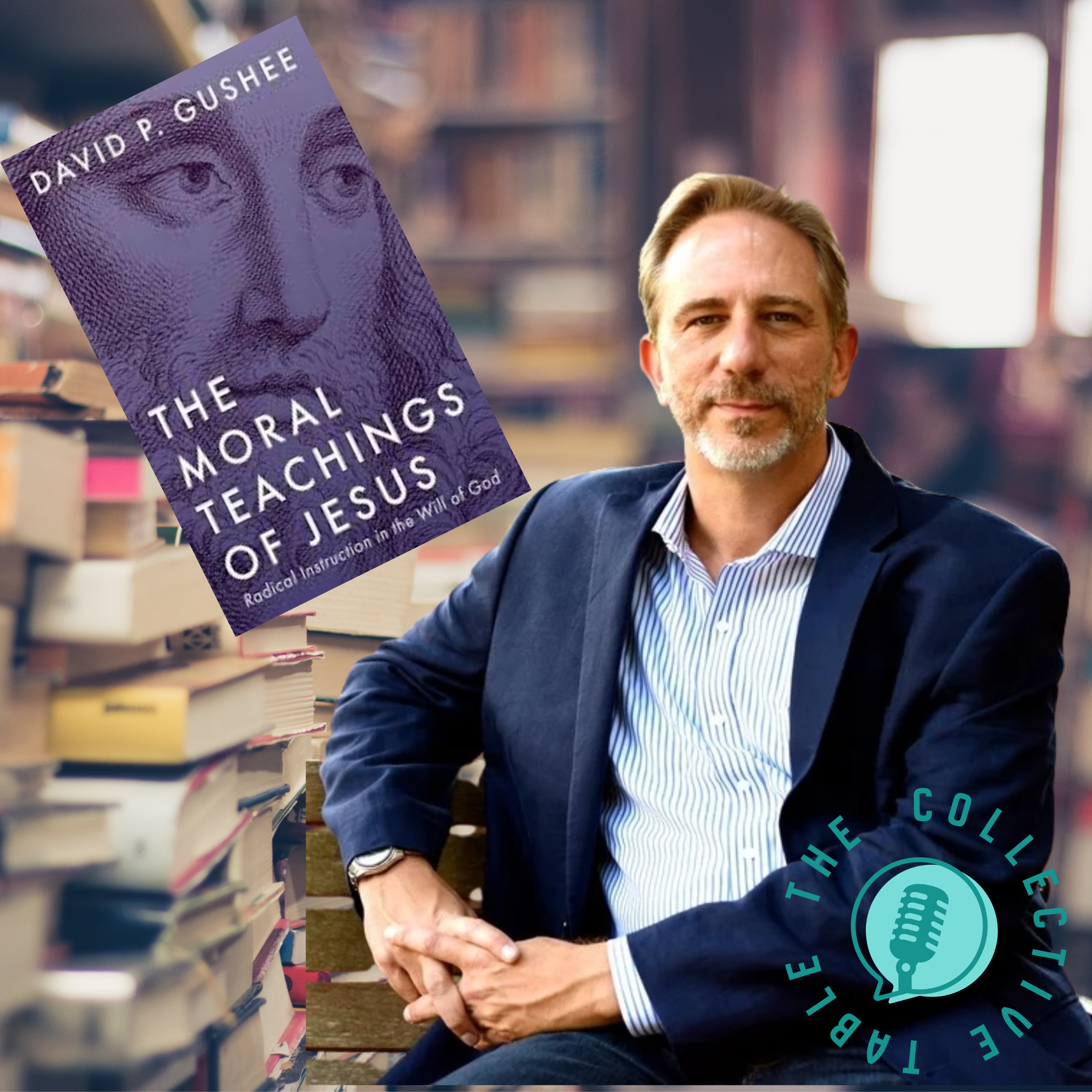
[email protected] There you can join the book club group, connect with other members, and hop into the live sessions right from our digital space. This month, our host, Jason Coker, along with other book club members, sat down with Dr. David Gushey, distinguished Professor of Christian Ethics and author of the Moral Teachings of Radical Inclusion in the Will of God. They discuss how Jesus teachings invite us into concrete moral transformation rather than just abstract doctrine or political identity. The conversation explores the transforming initiative found in the Sermon on the Mount, the challenges of reclaiming the Kingdom of God, language in the face of Christian nationalism, and the vital, evolving role of prayer for those navigating post evangelical spaces. Dr. Gushy also shares personal insights on his own spiritual rhythms and offers wisdom on how to approach the Bible not as a rule book, but as a treasury of faith for a community on a journey. So settle in and enjoy this thoughtful conversation between the TCT Book Club and Dr. David Gushey right here on the collective table.
[00:01:31] Speaker B: All right, well welcome everybody to the Oceanside Sanctuary Collective Table Book Club Podcast. We are really privileged Tonight to welcome Dr. David Ghashi this evening. One of the more influential Christian ethicists of our time, Dr. Ghashi spent more than three decades helping the church think with greater clarity and courage and compassion about what it means to follow Jesus in the modern world. He's a distinguished professor of Christian Ethics at Vrija University in Amsterdam and an author or editor of more than 25 books shaping contemporary conversations about faith and justice and discipleship. He is perhaps best known among progressive Christian pastors like myself for being an evangelical scholar who very publicly came out for full LGBTQ inclusion about Was it about 10 years ago?
[00:02:25] Speaker C: 11.
[00:02:25] Speaker B: Dr. Gushy 11 years ago and published a book at that time about it called appropriately Changing Our Mind.
Caused a lot of waves at that time and I'm sure made Dr. Gushy's life much, much easier in many ways.
His newest work is the Moral Teachings of Jesus Radical Inclusion in the Will of God in it calls us Back to the heart of the Christian faith, not just abstract doctrine or political identity, but to the concrete moral transformation into which Jesus invites his followers. Would you please join me in welcoming Dr. David Gushee. Thank you for joining us.
[00:03:07] Speaker C: Yes, hello, everybody.
Good to meet you this evening. And I only wish I was looking at the ocean. I picture you all looking at the ocean.
[00:03:17] Speaker D: Okay, we can fix that.
[00:03:19] Speaker B: Well, it is dark here right now, so unfortunately we're not gazing at the ocean at the moment. But it is a miserable existence here.
[00:03:27] Speaker E: There we go.
[00:03:29] Speaker C: Thank you. Thank you, Lucy. I needed that.
[00:03:31] Speaker D: I just fixed it for you.
[00:03:33] Speaker C: That totally gets me in the mood and ready to roll this evening.
[00:03:37] Speaker D: That's right, we're ready.
[00:03:38] Speaker B: Perfect. Perfect. Thanks, Lucy. So if it's okay, I would like to start by just reading an excerpt from this book.
Dr. Geshe. This is from chapter 15, Loving Our Enemies, which I don't know, for some reason feels really timely right now.
And this is found on page 71, right before this excerpt. You are writing about the. One of your main arguments in this book is that Jesus's teachings, especially the Sermon on the Mount, are not teachings that call us into perfection, but rather they call us into a way of transformation which shifts our perspective on how we hear and interpret those teachings and apply them to our lives. And then you're talking about these three teachings of Jesus that are very well known, very famous. There's turning the other cheek, there's going the extra mile, and so on. And so I want to pick it up right after you share those three examples and you say this.
All three of these examples add up to the following.
You wanted to make me feel weak, embarrassed and angry by dominating me. Instead, I will surprise you by my creative response in which I take moral control of the situation by refusing to retaliate.
Stossen. This is a reference, of course, to Glenn Stossen.
Stossen saw this as the transforming initiative and he did not get there first. This was how both Mohandas Gandhi and Martin Luther King read this text as well. It became the moral engine of their non violent civil disobedience strategies. As both Gandhi and King said, we will respond to your physical force with our soul force. Now, I want to skip ahead past the next paragraph because it's this next bit that I thought was really interesting and appropriate for a church like ours. In the next paragraph after that, you say, this transforming initiative is found in Matthew 5:44, with the rest serving as an explanation.
The imperatives in Matthew 5:44 are to love your enemies and pray for those who persecute you.
The exhortation to pray helps more than it might seem.
To love an enemy seems both inexhaustible and impossible. But to pray for an enemy, while difficult, is within reach.
Even if what we pray is to ask God that the enemy might stop doing harmful things to us, we are still bringing them before God.
And I really appreciated that particular unpacking of Matthew 5:44, because as a former evangelical pastor, sort of, you know.
[00:06:36] Speaker B: Move moved into the mainline sort of progressive space. One of the things that I've noticed is that one of the first things that people let go of, one of the first things people lose when they move from evangelicalism to say, a progressive expression of Christianity is prayer. In fact, one of the common things I hear is, what do I do with prayer? I don't know how to pray anymore. I don't know to whom I'm praying anymore. There's this sort of disconnection from the transcendent. And this sort of hints at a question I may ask a little bit later. But my question for you now is how has your thinking about prayer and your practice of prayer changed in, say, the last 10 to 15 years?
[00:07:26] Speaker C: I think you name an important.
[00:07:32] Speaker C: Phenomenon that.
That is even a little broader than that that when people leave evangelicalism or are pushed out, it often can destabilize their entire practice of Christian faith.
[00:07:53] Speaker C: What to make of the Bible, what to make of church, what to make of prayer.
[00:08:00] Speaker C: You know, what to make of the entire package of things that we were used to doing.
[00:08:09] Speaker C: And some people actually never recover from that. Really.
[00:08:14] Speaker C: For me.
[00:08:19] Speaker C: I.
[00:08:21] Speaker C: I no longer pray for.
[00:08:29] Speaker C: For God to solve my problems or to fix the world.
[00:08:37] Speaker C: But I do.
[00:08:41] Speaker C: I find myself more often praying with the liturgical prayers of the tradition of the church.
[00:08:52] Speaker C: Which.
[00:08:55] Speaker C: Have a. Have a logic to them.
For example.
[00:09:01] Speaker C: Most every morning, I either read from our. The prayer book that my wife and I did. I don't know if you've ever seen it. It's called.
[00:09:09] Speaker C: A morning and evening prayer book.
So we take a classic prayer from the tradition of the church in the morning and in the evening.
And it's interesting how often those prayers are about contemplating God's goodness or.
[00:09:27] Speaker C: Praying for our transformation into who God calls us to be.
[00:09:37] Speaker C: I also love the Lord's Prayer, which is probably my. My central prayer.
And I'm so glad that in the churches that I go to, almost always it is read or, I mean said every week, every time we gather, even every day.
[00:09:58] Speaker C: So.
[00:10:00] Speaker C: I would say I am praying to Orient myself spiritually and morally.
[00:10:07] Speaker C: I do pray for. I have a daily prayer rhythm that looks like this when I follow it. Sometimes I break down on it. But.
[00:10:17] Speaker C: On Monday, I pray for my own responsibilities and calling. On Tuesday, I pray for my family members.
On Wednesday, I pray for my friends.
On Thursday, I pray for the church and various churches that I'm associated with.
On Friday, I pray for my nation.
On Saturday, I pray for global concerns.
And on Sunday, I. I just pray with the church at church.
[00:10:47] Speaker C: So.
[00:10:49] Speaker C: I think that there's less in the way of spontaneous.
[00:10:55] Speaker C: Prayers. Maybe. I wish I. There were just as many, but more in the way of structured prayers that are formational.
[00:11:05] Speaker C: I guess that's what I would say.
[00:11:07] Speaker B: Yeah.
[00:11:09] Speaker C: But I am still praying. I haven't. I haven't lost my desire to pray or my ability to pray.
[00:11:17] Speaker C: Is maybe a lot less magical thinking than might once have been.
[00:11:22] Speaker B: Yeah, that's a good distinction or helpful distinction to make. And I.
I think that.
[00:11:29] Speaker B: For myself and for our church and for others who I know who have been on a similar journey, it does seem common that people will find a sense of guidance and solace in structured prayers, traditional prayers, or composed prayers, even if they are contemporary.
[00:11:51] Speaker C: Yeah.
[00:11:51] Speaker B: And I appreciate you calling out the Lord's Prayer in that sense. In our church, we pray some kind of written prayer every week.
And oftentimes what we're praying is somebody's.
[00:12:05] Speaker B: Translation or interpretation of the Lord's Prayer in contemporary forms, like Nicolas Lee's version of the Lord's Prayers is meaningful for many of us. But I also actually really appreciate it on that same note that you've taken a structured approach to a rhythm in your week.
So thank you for sharing that. That's. I think.
[00:12:32] Speaker C: Thanks for asking. I'm not often asked about prayer, so that's. That's meaningful. Thanks for starting there.
[00:12:36] Speaker B: Yeah. Well, if you don't mind, I'm going to ask you another personal question next. And that is, of course, why did you write this book?
At what point did you realize that you had this book percolating in you and that you were really compelled to undertake that work?
What brought you to that place?
[00:13:05] Speaker C: I would say that.
[00:13:10] Speaker C: It kind of.
My work in the last 10 years has had a kind of a logic to it that has unpacked or unfolded in a way, there was no plan, but now it seems like there was a plan.
[00:13:26] Speaker C: When I wrote Changing Our Mind.
[00:13:30] Speaker C: It was a shattering experience in terms of how the book was responded to by my former friends and colleagues in the evangelical world.
[00:13:42] Speaker C: And.
[00:13:45] Speaker C: It pushed me into post evangelical space.
And so I wrote a memoir in 2017 that was about.
[00:13:54] Speaker C: Kind of asking about the whole journey and where God has been in it and how to make sense of it.
And then I wrote a book called After Evangelicalism that was a kind of a guide for what comes next for post evangelicals.
[00:14:10] Speaker C: The Trump phenomenon.
[00:14:14] Speaker C: Led me to refocus my attention to democracy.
And so I wrote a book called Defending Democracy from Its Christian Enemies.
And as I was working on that book, I realized that there was.
[00:14:28] Speaker F: Some.
[00:14:28] Speaker C: Real.
[00:14:30] Speaker C: Spiritual malformation that had happened and moral malformation that had happened in American Christianity that helped to get us to where we were and are.
[00:14:44] Speaker C: And that making a case for the protection and preservation of democracy, I needed to do it, but that the next step was to call Christians back to the way of Jesus.
[00:15:00] Speaker C: Both because.
[00:15:02] Speaker C: Where Christianity had gone wrong in America had a lot to do with ignoring or rejecting or abandoning the way of Jesus.
[00:15:11] Speaker C: And also because I thought that if we were settling in for a long run of.
[00:15:20] Speaker C: Societal instability.
[00:15:23] Speaker C: Political conflict, and maybe even authoritarianism, that we needed to equip the church with resources at the very core of our faith.
[00:15:38] Speaker C: And I'm sensing that. And that's not just for post evangelicals. A lot of mainline churches are also reading the book.
[00:15:47] Speaker C: When crisis comes, we need to find solid ground.
[00:15:53] Speaker C: Solid ground to stand on society. If society is shaking like an earthquake, you all know about earthquakes in California, right? If society is shaking like an earthquake, where is there solid ground?
[00:16:08] Speaker C: What can we build our lives on? What can we build our churches on?
The answer has always been, I think the teachings of Jesus and the way of Jesus.
[00:16:21] Speaker C: But I, I. So partly it was, this is what comes next after the democracy book.
Partly it was I had done a lot on the teachings of Jesus in my book with Glenn Stassen called Kingdom Ethics, but that one focused on the Sermon on the Mount. I wanted to go beyond, to try to capture all or almost all of his moral teachings.
[00:16:49] Speaker C: And so.
[00:16:55] Speaker C: You know, and it's found a good response from churches across the spectrum. Some evangelical, certainly post evangelical, but also mainline.
There are churches that are using the book for like 40 week preaching series. You know, I mean.
[00:17:11] Speaker C: Solid ground for Christ's people.
[00:17:16] Speaker C: Because we need solid ground right now.
[00:17:24] Speaker G: Hello, Collective Table listeners, it's CJ again. A lot of people out there might not realize that this podcast is part of a real life faith community.
The Collective Table podcast is a production of the Oceanside Sanctuary, a progressive Christian community whose mission is to foster collective expressions of Inclusive, inspiring, and impactful Christian spirituality wherever it is needed. And as a 501c3 nonprofit organization, that mission is only possible because of the generosity of people just like you. So if you believe in what we are doing, if you benefit from this mission, please Visit
[email protected] Give to Become a Supporter today. Together, we can keep building communities of love and liberation.
[00:18:22] Speaker B: You know, your.
[00:18:25] Speaker B: Explanation of that, like, that process.
[00:18:29] Speaker B: Brought to mind that I think it was in 1997.
[00:18:35] Speaker B: My wife and I were relatively young ministers, part of the Vineyard.
[00:18:40] Speaker C: Oh, yeah, you're a Vineyard. Vineyard person. That's right.
[00:18:44] Speaker B: Yeah, yeah, yeah, yeah.
It was Ken Wilson who introduced us, actually. And so Ken indirectly.
And it was. And, you know, Ken was.
Was just one of my.
You know, one of the people I really looked up to in the Vineyard.
[00:19:02] Speaker B: But I think it was the 1997 National Vineyard Conference in Anaheim, California. I don't know what you were doing in 1997, but in. In the summer of 1997, my wife and I were at the national conference for the Vineyard Community of Churches, and two of the featured guests at that conference. This was shortly after John Wimber died.
[00:19:25] Speaker B: And his successor took over and Todd Hunter, who would go on to, you know, start the Anglican Mission in America.
[00:19:36] Speaker B: He got up and said that the two most important books that any of us as Vineyard pastors could read as quickly as possible were.
[00:19:47] Speaker B: Celebration of Discipline by Richard Foster and the Divine Conspiracy by Dallas Willard.
And, you know, being an excited and hungry young pastor, I went straight to the bookstore, bought both of those books. And.
[00:19:59] Speaker B: And.
[00:20:01] Speaker B: And I bring this up because it feels like we've been here before.
[00:20:09] Speaker B: You know, Dallas Willard's book, in particular, the Divine Conspiracy, was. Was phenomenally popular in the Christian world, and it took a different approach than the moral teachings of Jesus, but it was not dissimilar in its.
In its motivation to return the church to the solid ground of Jesus's teachings. And, I mean, it. It completely transformed my understanding of what it meant to be a Christian and in no small part was responsible for me ending up where I am now. You know, like, taking the teaching of Jesus seriously in that way led me to be shocked and appalled by, you know, the church doubling down on bigotry and hate.
And so I'm. I'm just wondering, like, what is your take on that? Like, it feels like we go through these cycles in church leadership circles, and it feels like, you know, for all of the efforts and energy that was expended in the spiritual formation movement.
Yeah, that it looks like on this side of it, that there's not much to show for it.
[00:21:27] Speaker C: I remember those two books. I read those two, those two books.
I remember sitting in a radio studio with Dallas Willard in the 90s. He died not long after that. I think.
[00:21:42] Speaker C: Sitting knee to knee with him, being interviewed by somebody in Southern California in a radio station.
A lot of. A lot of water under the bridge. Since then, I really respected Dallas Willard. Interesting. Because he was like a USC professor. Right. I mean, he.
[00:21:56] Speaker B: Yeah.
[00:21:57] Speaker C: He was not. Not your typical person to write a book like that. Right.
[00:22:00] Speaker B: Yeah. Well, like you, like you. He had a Southern Baptist history.
[00:22:04] Speaker C: Yeah.
[00:22:05] Speaker B: And ended up as a philosophy professor at uc.
[00:22:09] Speaker C: Yeah. Yeah.
[00:22:11] Speaker C: So it. Well, I would say.
[00:22:16] Speaker C: I would say that we both were in evangelicalism and we both, one generation apart, you might say, had concern about the direction of evangelicalism.
[00:22:36] Speaker C: And my reading is that.
[00:22:41] Speaker C: American evangelicalism has always lacked a stable theological center.
[00:22:50] Speaker C: Because it began in the 40s as a reframing of fundamentalism.
[00:23:01] Speaker C: A modernizing of fundamentalism in an effort to build a big tent coalition that could go everywhere from Calvinists to Arminians to Anglicans to vineyards to Pentecostals to charismatics to Baptists to Wesleyans.
[00:23:18] Speaker C: And if there was a doctrinal center, it tended to be, you know, some.
Some version of a Calvinist faith statement, you know.
[00:23:32] Speaker C: But that wasn't enough.
And I would say that certainly by the time Willard wrote Divine Conspiracy.
[00:23:40] Speaker C: Evangelicalism was calcifying into either doctrinaire right wing dogmatism.
[00:23:50] Speaker C: Or politicized Christian right politics.
[00:23:56] Speaker C: And that the way of Jesus, the teachings of Jesus, the soft hearted.
[00:24:03] Speaker C: Tender, courageous, passionate.
[00:24:08] Speaker C: Loving, justice oriented Jesus was not anywhere to be found in the. In the heart marrow of evangelicalism. Or at least not in the main embodiments of it.
[00:24:22] Speaker B: Yeah. Or at least not in those who ended up in power.
[00:24:24] Speaker C: In power. That's right.
[00:24:27] Speaker B: Because there's been a pretty significant exodus.
[00:24:30] Speaker C: Yes.
[00:24:31] Speaker B: Of leadership. Yeah.
[00:24:33] Speaker C: Leaders and, and people.
[00:24:35] Speaker B: Yeah.
[00:24:36] Speaker C: So, yeah, I think that.
[00:24:39] Speaker C: I mean, the radical idea that Christianity should be about Jesus, what he taught, how he lived, how he treated people.
[00:24:48] Speaker C: I don't know, we've been. I think Jesus is so radical, as I say in the book, and so challenging and it's so much easier to box them up doctrinally or politically.
And I think when you actually read these 40 teachings, burst through all of that. It's just not about that.
[00:25:13] Speaker B: Yeah, it's. It's annoying, honestly.
[00:25:16] Speaker C: It's really annoying. Yep. It's annoying because Jesus is always ahead of us, challenging us.
And so, yeah, I think Dallas Willard saw the problems.
[00:25:29] Speaker C: And there always was a pietist strand in evangelicalism.
We all, we want to be close to Jesus, we want to have a heart, heart relationship with Jesus, meaningful prayer life.
But I wouldn't say that that pietist strand prevailed within the movement.
[00:25:48] Speaker B: Yeah, yeah. Well, the other sort of interesting correlation is you, you center the kingdom of God because of course, Jesus centers the kingdom of God in his teachings. And so that leads me to my next question, which is, you know, you anchor this vision of Jesus's teachings as inviting us into moral transformation as teachings that are anchored in the Kingdom of God as a kind of transcendent reality, an eschatological horizon. Right, right, that's right. I think what's helpful about that and also challenging about that is that we live famously in a secular age. Right. Our concern, both outside of religious spaces and increasingly within religious spaces is for imminent concerns.
And so I think that focusing on the Kingdom brings like sort of two challenges that I wanted to ask you about. And the first is that by locating the source or the anchor for our moral transformation in the transcendent, is that hard to gain traction with for people who are very focused on what needs to be, you know, fixed or repaired here and now on the one hand. And then on the other hand, like maybe the more troublesome issue right now is that Kingdom of God language has been co opted by Christian nationalism for decades. This is not a new phenomenon.
Christian nationalists have been using Kingdom of God language in an imminent way to justify their seizing of political power.
And so I'm wondering, maybe as you're seeing churches make use of this book, how do you think that language can be effectively reclaimed from those two sort of difficulties? On the one hand, people who are shy about transcendence and then on the other hand, people who are uncomfortable with that language because of the way it's been abused.
[00:28:01] Speaker C: It's delicate.
I think it really helps to, to try to ground.
[00:28:08] Speaker C: To begin with what Jesus was probably doing with the concept and where he got.
[00:28:16] Speaker C: Is fundamentally a Jewish idea in its origins.
[00:28:22] Speaker C: God is king, God is sovereign. This is God's world, full stop.
[00:28:30] Speaker C: This means that God has the rightful rule of all of creation.
[00:28:36] Speaker C: This would mean that anybody who would want to be God's person would want to be living in such a way as to participate and obey God's will.
To obey God's will.
And then the participatory language is picks up. If we think of the idea that God sent Jesus to reclaim the World.
[00:29:03] Speaker C: For God's rule.
[00:29:05] Speaker C: So when Jesus says, repent, for the kingdom of heaven is at hand or near, he's saying the eschaton, the future, when God's will will be done on earth as it is in heaven, that promised future begins now.
[00:29:28] Speaker C: And good news, you're invited to say yes to that. Not just in theory, but in practice.
And even more good news, I'll teach you how to do that.
And that's what the teachings are about.
[00:29:45] Speaker C: So study with me as your rabbi, as your teacher, watch how I live and listen to my words and build your lives and your communal life as church on these teachings, which enables you to participate in the reign of God as it is dawning, breaking in now.
[00:30:08] Speaker C: So it isn't just transcendent because it has to do with everyday life.
It has to do with whether we forgive our enemies or whether we're generous with the poor, or how we treat our spouses or how we treat our children, or how we care for creation or how we relate to the poor, etc.
[00:30:33] Speaker C: So because all of the cosmos belongs to God and Jesus is reclaiming the earth for God, Jesus's people are those who are wanting to orient their lives according to what would please God, the will of God. And that's in every aspect of life.
I also think, as I say in the book, that Jesus is a great diagnostician of the patterns we get into that lead us away from God's will.
He really understands the brokenness.
[00:31:05] Speaker C: And the distortions of our thinking and the things that go wrong and says, hey, watch out for that. I offer you a better way.
[00:31:17] Speaker C: This has nothing to do with the United States of America being officially Christian.
It has nothing to do with the fortunes of a nation, the relative power of one nation over another.
[00:31:35] Speaker C: Now, some people think that kingdom language is intrinsically susceptible to being politicized in an unhealthy way.
And it may be that's why some people don't use the language. They may say reign of God, which is a little different, or they may say even kin. Dom, have you seen that one, Jason? Kin.
The realm in which everybody is treated as family. That's kind of nice.
[00:32:03] Speaker B: It is. It is kind of nice. It's very. It's very common amongst my friends who are oriented towards process theology.
[00:32:09] Speaker C: Yeah.
And it's a way of taking a vision of a transformed world in a less hierarchical sounding language. Right?
[00:32:19] Speaker B: Yeah.
[00:32:21] Speaker C: But the idea that everybody's serving something or somebody.
[00:32:29] Speaker C: Serve.
Serve God. As Jesus explained who God is, and that is not just you believe some Doctrines, but it's. You live as Jesus taught and that's every day.
[00:32:44] Speaker C: And so the church is a school of discipleship where we learn how to practice what Jesus taught.
[00:32:50] Speaker C: And that helps us to participate in the advance of God's reign, which we say will only be fully consummated upon Christ's return. But we get to live into that reality and help to help to, to give a glimpse of it through our lives today.
[00:33:06] Speaker B: Yeah, yeah, I appreciate that sort of well rounded response to some of those difficulties. I think that, you know, in, in my case, the reason I'm reluctant to let go of kingdom language is because I think that in using it, Jesus critique of power is especially sharp because he uses a term of power and authority and demonstrates that God's power and authority is altogether wholly different than the power and authority that they're accustomed to. And so, you know, it becomes an incredibly powerful critique.
It's true for Jesus to say, well, here's what God's kingdom looks like. And then for him to demonstrate in ways that are utterly foreign to anybody, you know, what a true king looks like.
[00:34:05] Speaker C: It's the kind of thing that gets you killed, actually.
[00:34:07] Speaker B: That's right.
[00:34:09] Speaker C: Because.
[00:34:12] Speaker C: It is subversive.
[00:34:13] Speaker B: Yeah.
[00:34:14] Speaker C: To come into Roman occupied Palestine.
[00:34:21] Speaker C: Especially Jerusalem, but anywhere in Roman occupied Palestine and say, hey, good news, the one true real king of the universe is taking the world back.
And by the way, that's not Caesar.
[00:34:35] Speaker B: Yeah.
[00:34:36] Speaker C: Is the kind of thing that gets you killed.
[00:34:38] Speaker B: Yeah, yeah, yeah.
Excellent. John, you had a question. Would you, would you be willing to pop in and go ahead and ask Dr. Ghoshy your question?
[00:34:51] Speaker B: No. You're still muted.
[00:35:01] Speaker F: You know, and, and your book points out. So Jesus's message is really pretty clear.
[00:35:09] Speaker F: From the Sermon on the Mount and the rest of this thing, the rest of the New Testament and the Gospels. And the thing that.
[00:35:21] Speaker F: That I keep wondering is what is it about.
[00:35:27] Speaker F: Our, our church?
Our church structures many of our church traditions that it seems that gets discarded or put to the side. And so much focus is on kingdom building.
[00:35:48] Speaker F: Powers, power structures and excluding and alienating people.
That is the antithesis of what Jesus called us to do. And I, it just seems.
[00:36:04] Speaker F: It perplexes me that so much, so many of our church traditions have seemed to have forgotten the major tenants of.
[00:36:18] Speaker F: Of our Savior who, who was very clear in what he expected of us.
[00:36:26] Speaker C: It's really quite extraordinary, John.
[00:36:32] Speaker C: We have permanent written records.
[00:36:36] Speaker C: Of various accounts of the things that Jesus said.
And so we have the person we name as the center of our Faith. And we have massive, extensive records of the things that he said.
[00:36:54] Speaker C: And yet we drift away from those teachings or directly disobey them on a routine basis and focus on almost anything else.
[00:37:09] Speaker C: It must be that we are made uncomfortable by the demands of the one we claim as Lord. And so if we can distract ourselves by doing anything else, we're perfectly happy to do that.
[00:37:26] Speaker C: I can't think of any parallel.
[00:37:30] Speaker C: I don't know. I'm a big baseball fan. It'd be like.
[00:37:35] Speaker C: Studying a book on multiple books on baseball, hearing all about it, and then doing anything other than playing baseball. We. You're gonna throw a Frisbee or, or bake a cake or anything. Anything else other than what's the center of what we say we're about.
I think.
[00:37:55] Speaker C: There was a movement that was originally so impressed by the vision and the practice and the teaching and the personality, and then the horrible death and, of course, the resurrection of Jesus that a whole religion was born based on it.
But over the centuries.
[00:38:14] Speaker C: Various versions of drift and denial of that main.
[00:38:18] Speaker C: Meaning have always resurfaced.
[00:38:22] Speaker C: Now there's a specific moment in Christian history that I think is more important than any other moment for that, and that is, ironically, when the Emperor Constantine embraced Christianity and made it their religion, official religion. Eventually it became the official religion of the Roman Empire.
After that, after three centuries of marginalization and, and sometimes persecution, the church became a power broker.
[00:38:51] Speaker C: Very close to the throne.
And it has stayed that way in large parts of the world ever since.
And so the church has been about power, political power, economic power.
[00:39:08] Speaker C: And then building big things, big buildings, big memberships, big budgets, big influence.
And then if, if you manage to do that, then there's jockeying for position and, and who gets to be the top dog. And. And again, all those things that Jesus explicitly warned against.
Right.
[00:39:30] Speaker C: This is one reason why many theologians think the worst thing that happened to Christianity historically was when Constantine adopted it as the official religion, as his religion, and then it became the official religion of the Roman Empire.
We developed the pattern of power, the habit of power, massive power, economic, political, and social.
[00:39:51] Speaker C: The church is usually healthier when it's threatening to be a believer rather than a privilege to be a believer.
[00:40:05] Speaker F: And, and if I can just add, you know, and relating it to, to myself and my walk.
[00:40:15] Speaker F: In, in my years of being an evangelical and, and now post evangelical, I guess you would.
[00:40:21] Speaker C: Say.
[00:40:23] Speaker F: I. I felt very comfortable being. Serving on a church committee or working on a church budget or doing different projects, but.
[00:40:34] Speaker F: I got very uncomfortable going out and really helping people individually.
[00:40:41] Speaker F: It was easier to be busy with the busyness of church versus really attending to the needs of, of of people and going into different parts of town and you know.
[00:40:58] Speaker F: Involving myself in others lives that I had no nothing in common to. I'd much be on my computer putting a spreadsheet together for the next budget meeting as opposed to doing what Jesus did, which was be out and serving and helping people.
[00:41:20] Speaker C: I appreciate that honesty, John. I totally can identify with that.
[00:41:26] Speaker C: I mean, Jesus found himself in some very unlikely places having conversations with some very unlikely people.
[00:41:35] Speaker C: Situations that could be described as dangerous or certainly.
[00:41:41] Speaker C: Uncomfortable and sometimes scandalous.
[00:41:49] Speaker C: But he was utterly unafraid.
[00:41:53] Speaker C: This one reason I, I really, and it's really important to say.
[00:41:59] Speaker C: The close the more closely I study Jesus teachings, the more impressed I am with Jesus and the more challenged I am.
[00:42:09] Speaker F: Yeah.
[00:42:09] Speaker C: And the more humbled I am.
I. I'm not very good at doing all of this stuff.
[00:42:16] Speaker F: Yeah.
[00:42:17] Speaker C: But I sure wish I was.
I want to be a Christ follower.
[00:42:23] Speaker C: And I think if that's our posture, that's the, that's the posture to start.
Pride. Pride is the opposite. Right. I think we're brought to our knees when we look at the things that Jesus teaches and like help me to be this kind of person. But I also think the church is a place where we have that conversation together. How do we do this? Yes, how do we do this?
[00:42:51] Speaker F: Yeah.
[00:42:51] Speaker C: Not just how does John do this? But how do we do this?
It's a lot easier to do it in a group than on our own.
[00:43:01] Speaker B: Thank you for that, John. I appreciate you being willing to ask that question.
Lori is on this zoom as well from her phone and she typed in this comment and question and asked me to go ahead and share it. She wrote, I came upon this book club opportunity after discovering Dr. Gushy.
Grateful to be able to attend as I'm not part of the church, I left the church.
Evangelicalism felt unwelcome 22 years ago when I entered into a lesbian relationship. Been with my partner since then.
Discovering and reading your book about post evangelicalism in the last month has been revolutionary for my spirit and soul.
When I left evangelicalism came to a born again faith via intervarsity during college I found that I could still pray, albeit much less often.
But I realized that I directed my prayers to God.
I think reverting to my childhood experience in the Lutheran church and no longer to Jesus. I'm curious your thoughts on this.
Do you pray to Jesus?
[00:44:12] Speaker C: Well, first of all, Laurie, thank you for joining us. And I'm really glad that.
[00:44:21] Speaker C: That my. My writing is being helpful to you. And thanks for asking that question.
[00:44:29] Speaker C: I think.
[00:44:31] Speaker C: I'm a Trinitarian Christian.
I take the classic trinitarian formula seriously. Father, Son, and Spirit.
[00:44:43] Speaker C: And there are times where I find myself addressing my prayer to each of each one of those three.
[00:44:55] Speaker C: There are times when I'll say, oh, Spirit, Holy Spirit.
[00:45:01] Speaker C: Guide my words in this conversation.
[00:45:07] Speaker C: Help me to feel with this person and to know what you want me to say.
[00:45:17] Speaker C: There are times that I prayed to Jesus. Jesus, more like help me to be like you. Help me to imitate you. Help me to obey you.
[00:45:29] Speaker C: So there are times where praying to Jesus directly comes more naturally, and there are times that praying to God the Creator, God the Father, also comes more naturally to me.
I think we're really welcome to.
To address our prayers to any or all of the above.
[00:45:49] Speaker C: And.
[00:45:52] Speaker C: I think we have the freedom to do that. And actually it can be an enhancement of our prayer life when we feel free to do that.
So I would say direct your prayers as you feel moved and feel confident that God hears those prayers.
[00:46:09] Speaker B: Yeah. Thank you for being willing to pop your question in the chat.
[00:46:12] Speaker C: Absolutely.
[00:46:17] Speaker G: Hey, C.J.
[00:46:18] Speaker B: Here.
[00:46:18] Speaker G: We want to take just a quick break to tell you about something we are really excited about. We've just launched the Sanctuary Community. It's a safe and inclusive place for progressive Christians to connect with each other, learn and grow together and work together to impact their communities.
You'll find thoughtful conversations, groups and classes and helpful resources for growing in your Christian spirituality. If you've been looking for a place where you don't have to hide who you are, where Christianity is expressed in love and liberation, then this community is for you. You can join us
[email protected] we can't wait to see you there.
[00:47:07] Speaker B: Lucy, I noticed that you popped a question in. Would you be willing to ask that directly?
[00:47:12] Speaker D: Hi.
Thank you for being here tonight with us.
[00:47:15] Speaker B: Sure.
[00:47:17] Speaker D: I'm wondering if Jesus once wanted us to be exactly as he prescribed as he laid out in his teachings, insofar as maybe he was looking for us to put something out there to keep us mindful of what we're striving for. Because I don't think of it as a place of arrival as so much as I think of it sort of like a process that constantly.
[00:47:46] Speaker D: Honing and adjusting as I'm going along in my life.
And so I don't think of this as a place of arrival. I think of it as a.
[00:47:59] Speaker D: Process that we're continually evolving.
[00:48:04] Speaker C: I think that's a really nice insight. Lucy.
[00:48:08] Speaker C: Take the teaching.
[00:48:16] Speaker C: Do not store up treasures on earth, but instead treasures in heaven.
Okay.
I think in general, in context, in the Sermon on the Mount, what that means is.
[00:48:29] Speaker C: Do not focus on material acquisition.
[00:48:33] Speaker C: But instead on.
[00:48:36] Speaker C: A life that pleases God.
[00:48:40] Speaker C: Including in context, a life of generosity to others.
Okay.
[00:48:49] Speaker C: That is directional teaching.
Right.
[00:48:56] Speaker C: When would one arrive at having mastered that?
[00:49:03] Speaker C: Never.
No one would never master that.
As soon as you think you've mastered that, then you're really in trouble.
[00:49:10] Speaker D: Right, Exactly.
[00:49:12] Speaker C: Right.
So.
[00:49:16] Speaker C: So the prayer is, God, help me to live in a way that looks like that. And then what does that look like today?
[00:49:25] Speaker B: Right.
[00:49:26] Speaker C: What does that look like next week?
In this particular situation, what would it look like?
What do I do with my financial investments? What do I do about insurance? What do I do about how I spend my money?
[00:49:42] Speaker C: You know?
[00:49:46] Speaker C: So.
[00:49:48] Speaker C: It also helps to remember that because Jesus social context was different from ours, we face different kinds of challenges.
[00:50:00] Speaker C: Love your enemies is a teaching that I think is.
Is authoritative for followers of Jesus.
But who our enemies are probably looks different from who Jesus enemies were, right?
[00:50:14] Speaker B: Yeah.
[00:50:14] Speaker C: But the teaching resonates still and challenges us.
Right.
[00:50:20] Speaker C: I really like the image of Jesus walking ahead of us saying, come on, follow me.
You're always on the journey.
[00:50:28] Speaker B: Yes.
[00:50:29] Speaker C: You're always on the journey until this journey ends.
[00:50:33] Speaker F: Right.
[00:50:35] Speaker C: And you never arrive.
[00:50:37] Speaker D: I guess I feel like that there.
[00:50:38] Speaker C: Are a lot of.
[00:50:39] Speaker D: I sense that there are a lot of people in some churches that are looking for this arrival. They're looking for the certainty.
And.
[00:50:49] Speaker D: I just.
[00:50:52] Speaker D: I. I'm not sure. I mean, I just tell people, you know, if you're looking for certainty, this is not the place to look.
[00:51:05] Speaker C: It is a general characteristic.
[00:51:09] Speaker C: Of some versions of Christianity to major uncertainty.
If you get baptized in this way, you will go to heaven, period. That's it. And that's all that matters. Or if you confess this doctrinal creed, you are right with God.
[00:51:27] Speaker B: Right.
[00:51:27] Speaker C: Period.
[00:51:29] Speaker A: Right.
[00:51:32] Speaker C: And.
[00:51:35] Speaker C: I think people so much want certainty, and there are things I. I want to be certain about.
I am certain that Jesus is the one I'm trying to follow.
[00:51:45] Speaker C: But. But there's a dynamism about the path.
[00:51:50] Speaker C: Following is a.
Following is a dynamic image, isn't it? He's moving, and then we are too.
It's a journey image. The imagery of pilgrimage is helpful too. Like, we're on the way.
People talked about the way of Jesus. It's a. It's a path Language. It's a movement image.
[00:52:15] Speaker C: Really different from a. I've arrived because I've got the right creed. Mm.
[00:52:21] Speaker C: Right.
[00:52:22] Speaker B: Well, I love. I love that you brought that up, because I think one of the things that's really powerful about the notion of pilgrimage is that it uses an arrival point.
[00:52:31] Speaker B: To draw us into a journey, but it's the journey that changes us. Right. It's like. It's like there's this intrinsic motivation that, you know, we need to arrive, that there's a destination ahead of us, but it's the journey that.
[00:52:47] Speaker C: That affects us, and that's why people do it. If you go on the pilgrimage, what, the.
The one. The one in Spain, what do they call that?
[00:52:55] Speaker B: The Camino.
[00:52:55] Speaker C: Yeah, the Camino.
It's the journey. That's the point.
[00:53:00] Speaker B: Yeah.
[00:53:00] Speaker D: Yes.
[00:53:01] Speaker B: All right.
[00:53:03] Speaker C: And I also. That also helps with the. With the church.
[00:53:08] Speaker C: The church is a community of journeyers, fellow journeyers. We do this together.
I really envision, like, let's say Jesus says, forgive if you want to be forgiven, forgive.
[00:53:21] Speaker C: How many times am I supposed to forgive?
Remember that?
[00:53:25] Speaker F: A lot.
[00:53:27] Speaker C: 70 times? Seven. Right. How many times for every human being. Forgiveness is hard.
[00:53:34] Speaker C: If it wasn't hard, he wouldn't have to teach us about it.
[00:53:39] Speaker C: So I envision the church as a place where Lucy could say to Caroline.
[00:53:45] Speaker C: Privately, publicly, Caroline, there's this person I need to tell you about who I'm having trouble forgiving.
[00:53:53] Speaker C: And I really know that I need to forgive this person. It's eating me alive.
And Caroline could say, can we pray about that? Can we talk about that? How can I help you?
Can I talk through the situation with you? Where's the pain? What would it look like to try to forgive here?
Non judgmental, but directional community.
We're trying to go somewhere and we. And we help each other do that.
Lovingly, non judgmentally.
I love that image of the church, a community on the way together.
[00:54:27] Speaker B: Yeah.
[00:54:29] Speaker C: It also makes church very purposeful. It's not just a place that we go on Sunday. It's a community where we learn how to practice this.
This demanding but life giving way of Jesus.
[00:54:39] Speaker B: Yeah.
[00:54:43] Speaker B: Leanne popped into the comments, and I'm going to put her on the spot here, if that's okay. I think I can do that because she's technically one of our elders, so that's part of the job description.
[00:54:54] Speaker C: Look what happens to you, Leanne. You become an elder and you lose your freedom. Okay. Okay.
[00:54:59] Speaker E: You're supposed to read what I say.
[00:55:01] Speaker B: I am going to read it, but.
[00:55:03] Speaker E: Oh, no.
[00:55:06] Speaker B: She wrote, I love the discussion about prayer. It totally resonates with me.
And she wrote, I have always loved talking to Jesus, God, and the Holy Spirit, referencing your response to Laurie. But then Leanne wrote this, which I thought was really interesting. She said, through my reconstruction, because Leanne, like many of us, has been through a change in the way she thinks about her faith and about God and Christ.
She writes, through my reconstruction, I found that my prayers continue to feel more powerful or more real.
And, Leanne, that is such an unusual thing for somebody to say that I have to ask you if you would be willing to share more about that. What do you mean that your prayers have begun to feel more powerful or more real?
[00:55:56] Speaker E: Thank you, Jason.
[00:56:00] Speaker C: I hear irony or sarcasm there, Jason. I mean, it may just be me.
[00:56:04] Speaker E: But anyway.
[00:56:07] Speaker E: I just.
[00:56:09] Speaker E: I've always loved, as I said, I've always loved in my Christian walk.
[00:56:15] Speaker E: That whole communication.
I feel like I can talk. Jesus is right here. God is always with me, the Holy Spirit and all of that.
But I think when I started to kind of unpack the thing, the.
What I was taught originally that I still hold on to in some ways, but that I taught originally.
And I'm rethinking Scripture and rethinking how when I have in my heart that something doesn't feel right, that I feel like the Lord is taking me on this journey. And it's quite the journey of communicating my concerns, you know, through prayer, through groups like this.
[00:57:05] Speaker E: And there's a powerful thing, more. More power I feel. And I'm not saying it's right, but I feel like there's more power when I am saying things like, this is what I was always taught before, but now I see it differently. Now I feel like the Lord is taking me on a journey that's going this way instead of this way. And I don't have to worry about questioning.
[00:57:31] Speaker E: Whereas before I did, I wasn't able to question or have a dialogue outside of the little box.
[00:57:41] Speaker C: Thanks for explaining that, Leanne. What. What that brings to mind for me is.
[00:57:47] Speaker C: Is that a lot of what characterized a lot of evangelical communities was a strong emphasis on boundaries.
[00:58:00] Speaker C: Boundaries of doctrine that must not be approached.
[00:58:03] Speaker F: Yeah, yeah.
[00:58:05] Speaker C: Because these were.
These are non negotiable. They are.
[00:58:12] Speaker C: Unquestionable, love. The LGBT issue is one of them, but there's other ones. Right. The inerrancy of the Bible, for example.
[00:58:22] Speaker C: Right. And.
[00:58:25] Speaker C: And so what happens is if a person begins to have questions about that, questions for God and questions for the church. Well, the questions cannot be asked.
[00:58:37] Speaker C: Because the questions are destabilizing and, and they are swatted away or actively suppressed.
Many people have had the experience of going to a pastor and saying, pastor, I. I'm troubled by the passage in Joshua where God seems to command the slaughtering of entire villages.
And, and then the pastor says, all scripture is inerrant. Just trust God and don't ask any more questions.
[00:59:08] Speaker C: That, that is.
[00:59:10] Speaker C: Actively harmful, I think, to.
[00:59:15] Speaker C: To spiritual development.
[00:59:18] Speaker C: And so to be in a space where.
[00:59:21] Speaker C: Where you have more freedom to breathe free air and to ask your questions and to know that God can handle them can actually be very reviving for faith.
[00:59:31] Speaker C: Because God is a God who's on that journey with you instead of telling you all the things you're not allowed to ask.
[00:59:38] Speaker C: So. Absolutely, yeah. So I'm glad that you're having that experience.
[00:59:42] Speaker E: I am. I will say that just hearing you talk about reading scripture often. I have.
[00:59:50] Speaker E: I do, I do read scripture. Nothing like I used to because I had to and this is what I was supposed to do. And so there's that fine line between I don't want to go back to feeling like I have to do something or I'm missing the, you know, target. I don't know, whatever that was. And so I love that you shared how much you do reflect on, on scripture, you know, and, and I love that. And it's going to challenge me to not have that guilt of, or the identity of what it was like before, maybe.
[01:00:27] Speaker C: Yeah. I think this is a lot of the deconstruction reconstruction thing.
[01:00:34] Speaker C: When certain religious practices were treated as burdensome obligations.
[01:00:42] Speaker C: If I don't read the Bible every day for 30 minutes, I'm a bad Christian.
[01:00:48] Speaker C: Okay.
And then.
[01:00:52] Speaker C: So then it's all about guilt and shame for not doing what you're told to do.
[01:00:57] Speaker C: But if it's. Instead, I want to read the Bible, especially the parts of it that are most life giving, because I want to. I want to know how to live this life. I want to. I want to live the best way that I can.
These texts are giving life to me. They're giving me direction, they're giving me insight.
[01:01:15] Speaker C: Then, then it's not a burden, but a joy.
[01:01:20] Speaker C: Right. We do so much better when we're drawn towards something with joy instead of being beaten over the head and neck with shame and guilt.
[01:01:30] Speaker E: Yes, I appreciate that. Yes.
[01:01:32] Speaker C: Yeah.
[01:01:33] Speaker D: Thank you.
[01:01:34] Speaker B: So. So, first of all, David, if you're not going to let me use guilt and shame to build this church, you're taking away two of the most effective tools I've got.
[01:01:48] Speaker B: But secondly.
[01:01:52] Speaker B: Secondly, that's actually a great segue into one of the other questions that I shared with you in advance. And that is. And because you guys are really already talking about it, and that is the question about how people who come through a process of deconstruction or have extricated themselves from maybe high control or authoritarian oriented communities of faith oftentimes don't know how to read the Bible anymore.
Or even if they've changed their convictions about God or theology or specific issues like LGBTQ relationships or hell or what have you, they still have this very ingrained habit of when they come to the text, you know, they slip back into this old habit of reading it and internalizing it in an authoritarian way.
[01:02:48] Speaker B: And I've found that that's, that's just one of the most difficult hurdles to overcome is that they hear the voice of the text, the voice of God, as a kind of highly controlling, even shame inducing voice.
And so on the one hand, your book is encouraging us to take the teachings of Jesus seriously, which presumably would require taking the Bible seriously and reading the text and digesting it and wrestling with it.
[01:03:20] Speaker B: However, for many people, that's, that's a difficult task because they have a hard time disentangling from those old patterns, those old habits.
And also, and maybe I'll just add to this, if they've been through a pretty rigorous sort of rabbit trail of deconstruction, they maybe have been exposed to, you know, critical scholarship or form criticism, and they've begun to see that the Bible itself is a constructed reality, that the Bible itself is a discourse between authors and later interlocutors and later editors. And that what that does then is it sort of displaces any sense of authority that they used to have placed in the text.
So I'm wondering, Dr. Gushy, what would be your prescription for people suffering from that particular malady?
[01:04:17] Speaker C: Pinot Grigio? No, just playing.
[01:04:21] Speaker C: So.
[01:04:24] Speaker C: That helpful? Very helpful.
[01:04:25] Speaker B: That's okay. We can, we can end there if you'd like.
[01:04:27] Speaker C: Okay. Yeah.
[01:04:32] Speaker C: I would say.
[01:04:37] Speaker C: That if we think of the, the Bible as a collection of texts.
[01:04:45] Speaker C: That have been made sacred by the church and before that by the Jewish people in the Hebrew Bible.
[01:04:55] Speaker C: And that the church has chosen to elevate to.
[01:05:03] Speaker C: Authoritative status.
[01:05:10] Speaker C: Kind of a treasury.
[01:05:13] Speaker C: Though, an uneven treasury. Some, some of it is gold, some of it is silver, some of it is bronze, and some of it is less than that.
[01:05:22] Speaker C: And actually all of us who really read the Bible seriously know that not Every passage.
[01:05:28] Speaker C: Carries the same kind of inspirational goodness to it, you know.
[01:05:36] Speaker C: But it's a treasury of. Of works received by the church as authoritative.
[01:05:44] Speaker C: We are invited to dig around in that treasury on a regular basis.
[01:05:52] Speaker C: To see what it has to offer.
[01:05:56] Speaker C: And to dialogue with it, sometimes to wrestle with it and to look for what God might want to say to us through it.
[01:06:07] Speaker C: So the reason on Sunday morning why we read the Bible instead of Emerson or Thoreau or the Quran is because we are Christians who are part of a tradition that takes the Bible as the central authoritative text.
[01:06:26] Speaker C: But.
[01:06:29] Speaker C: How we read the Bible can be.
Can evolve to be more of a conversation and less of a dictation.
[01:06:41] Speaker C: And one of the things I love on the other side of.
[01:06:47] Speaker C: Evangelicalism is the ability to acknowledge the diversity of the texts of the Bible and the fact that they do not all speak with one voice.
[01:06:58] Speaker C: You know, I haven't told you this yet, Jason, I don't think, but I've just completed my next book, which is on the Book of Job.
[01:07:05] Speaker B: Oh, that's. That's very exciting. Actually, I have. Okay.
[01:07:09] Speaker C: I have a new book coming out in the fall on the Book of Job.
And one reason I selected Job is because you can see the arguments.
[01:07:20] Speaker C: Job as a book is arguing with other books in the Old Testament, and there are arguments. The whole structure of the Book of Job is a structure of arguments.
[01:07:32] Speaker C: Job definitively teaches us that it is okay to argue with each other and with the text and with God and with God, and that there is a lot of beauty in that process.
[01:07:48] Speaker C: We were taught, as evangelicals are kind of univocal. The Bible speaks in one voice.
[01:07:54] Speaker B: Yeah.
[01:07:55] Speaker C: The Book of Job puts that to the lie right there in one book.
[01:07:59] Speaker B: Yep, yep.
[01:08:02] Speaker C: So.
[01:08:05] Speaker C: If you think of the Bible more like, okay, you go to the buffet. You know, go. You have buffet restaurants near Oceanside. Okay, you go to the buffet, and there's this thing that looks pretty good, and there's that thing that looks pretty good, and there's that thing that looks interesting. I'm not sure about that thing, but it's all part of the buffet.
[01:08:26] Speaker C: It all, or almost all, can nourish us in one way or another.
[01:08:33] Speaker C: But what we have a taste for at one time may be different from the same thing at a different time.
[01:08:40] Speaker C: And what different people in the community will find inspiring, other people won't.
But what part of what constitutes us as a community is that? This is the text we are wrestling with. This is our buffet.
[01:08:55] Speaker C: It's not the only thing on our buffet, but it's the main thing that we read, the main thing that we consume.
And.
[01:09:03] Speaker C: And the reason we do that is because we are Christians.
But.
But in a. In a community like I'm envisioning it, we're going to center Jesus.
[01:09:15] Speaker C: I really regret when, say, somebody gets stuck in Leviticus and can't get out.
Right.
Don't get lost in Leviticus. Okay? Don't get lost in the Kings.
Don't get lost in the Book of Revelation.
Center on what should be centered.
[01:09:35] Speaker C: And I think the role of clergy partly is to help people find the most nourishing.
[01:09:43] Speaker C: Diet of Scripture.
[01:09:46] Speaker C: You design a preaching program and a teaching program to, you might say, nourish the congregation as well as possible. By the way, you didn't ask me this, but one reason I'm a lectionary person.
[01:09:59] Speaker C: Is because the lectionary tradition is already curating the texts.
[01:10:06] Speaker C: So that the best are put in front of us the most frequently.
And then, you know, in the. Both the Catholic and the Protestant lectionaries, there are some texts that are never read at all.
[01:10:20] Speaker C: Which says something in the church's wisdom. They decided a long time ago that not every text is equally nourishing.
[01:10:26] Speaker B: Yeah, that does say a lot. You're right.
[01:10:30] Speaker B: Well, so some of the people here who attend our church on a regular basis are like, lectionary. What's the lectionary? And I'll just say we do preach from the lectionary from Advent to Easter, and then we do the, you know, typical evangelical thing after that.
[01:10:46] Speaker C: Okay.
[01:10:47] Speaker B: But we are running out of time, and I don't want to keep you for too long. Certainly not longer than we promised. This conversation has taken a little different direction than I expected. I really appreciate the questions that you all brought for Dr. Geshe.
And I think it's been.
[01:11:05] Speaker B: Really surprisingly.
[01:11:08] Speaker B: Nourishing that we ended up talking about prayer for the majority of our time. I thought that was really, really helpful. A couple of notes. One is, as a reminder, the book is the Moral Teachings of Jesus.
If you haven't had a chance to pick it up, I highly recommend it. Also, two other books that came up that I might as well go ahead and recommend. One is the Divine Conspiracy by Dallas Willard. I do still recommend this book. If you can read it. It's well worth it.
[01:11:36] Speaker B: It's, I think, an excellent companion to Dr. Gushy's work. And then, of course, because he references him so much in this book, I'll just mention this book by Glenn Stossen, Living the Sermon on the Mount. Dr. Stossen taught at Fuller Seminary while I was there before his passing in 2014. And so I just deeply appreciate that Dr. Stossen is featured prominently in your work.
[01:12:03] Speaker C: So that's great. Thanks, Jason.
[01:12:05] Speaker B: Yeah.
Thank you so much for joining us. Can we give our guest a bit of a hand?
[01:12:13] Speaker C: Thanks, everybody. And, Jason, thank you for having me. I mean, I'm glad it. We ended up talking about prayer a lot.
[01:12:20] Speaker B: Me, too.
[01:12:21] Speaker C: Jesus talked about prayer quite a bit.
[01:12:23] Speaker B: Yeah.
[01:12:24] Speaker C: I would just maybe close with this. Ultimately, one of the things that impressed me about studying for this book is Jesus talked a lot about trust.
[01:12:35] Speaker C: And for him, prayer was an expression of trust in the goodness of God.
[01:12:41] Speaker C: And I'm convinced that his diagnostic was. One thing that goes wrong for people is that our anxiety gets the better of us. We don't trust God.
And so we try to secure our status, our.
[01:12:59] Speaker C: Emotional security, our prosperity by doing things that harm ourselves or other people or separate us from God.
And so one reason to practice prayer is.
Is because we trust God. And to. Also. To help us trust God more.
[01:13:16] Speaker B: Yeah.
[01:13:17] Speaker C: And also to help us orient our lives from a posture of trust instead of a posture of anxiety.
[01:13:26] Speaker C: And. And.
[01:13:29] Speaker C: And that's what I. My. My pastoral word to this church and anybody listening would be.
[01:13:36] Speaker C: Trust God and trust that Jesus has some really good ideas as to what a good and flourishing life looks like.
And so go with open and trusting heart, not in fear or anxiety, but in confidence that there is wisdom here for living that can. That. That we need.
[01:13:56] Speaker B: That we do desperately need, maybe more than ever.
[01:13:59] Speaker C: Yep.
[01:13:59] Speaker B: Thank you. Thank you very much, Dr. Gushee. And thank you everybody who is able to join us tonight. Just as a reminder, this will be available. The recording will be available on YouTube and on Apple and podcasts and Spotify come Monday. So if you want to review it or for those who weren't able to, you can always share that. This. Thanks so much.
Have a good night, Everybody. Thank you, Dr. Becci. Take care.
[01:14:24] Speaker C: Good night.
[01:14:31] Speaker A: Thanks so much for joining us for this episode of the Collective Table Podcast. If you enjoyed the podcast, please consider leaving us a review. If you are interested in the broader work we do here at the Oceanside Sanctuary, please visit us online at www.oceansidesanctuary.org. we will see you next.